Abram and Sura
Named in recordParents of Izrael Dawid, named in the Łódź ledger
Family research dossier · Żelechów — Warsaw — Łódź — Dzierżoniów
העפנער · געפנער
A working archive for the line of Avraham Yitzhak Hepner, a Kohen buried in Warsaw in 1933, and Majer Gepner, born in Łódź in 1918. It holds the original family photographs and separates what the records say from what we still assume.
The line is now documented across four generations. Avraham Yitzhak Hepner, buried in Warsaw in 1933, was born in Łódź on 30 August 1885 to Srul Dawid Hepner, a weaver from Żelechów, and Hendla née Gottheld. He married Gitla Hamer in 1913, and their five children — Zysla, Henia, Majer, Moshe and Yehoshua — were born on a farm at Łazy near Warsaw. The proof is the Łódź permanent-population ledger, pages 138 to 140, read on 8 September 2026.
Parents of Izrael Dawid, named in the Łódź ledger
Father of Avraham Yitzhak — documented
Kohen · son of Srul Dawid and Hendla
Eldest son of Abram Icek and Gitla — documented
אברהם יצחק העפנער
Born 30 August 1885 in Łódź (ledger, page 138). Released from military service in 1906; married Gitla Hamer of Biała Rawska on 25 December 1913; five children born at Łazy, gmina Falenty, near Warsaw, 1914–1923. Died 9 December 1933 aged 48 and buried at Okopowa, sector 73, row 30, grave 30.
ישראל דוד
Born 1854 in Żelechów, son of Abram and Sura, a weaver. Married Hendla Gottheld (1858–1914); eight children between 1878 and 1902, Abram Icek born 30 August 1885 among them. Registered in Łódź on a Garwolin permit of 1891 at house 754. His 1916–1921 card records the move to Warsaw in June 1920; a 1927 identity-card stamp shows him still alive.
Born 14 March 1918 at Łazy near Warsaw (ledger, page 140; the 1948 passport gives 5 May 1918, Łódź). Sisters Zysla (1914) and Chendla — Henia (1916), brothers Moszek — Moshe (1921) and Szyja — Yehoshua (1923). His postwar Polish passport records residence in Dzierżoniów and validity for travel to Italy in 1948.
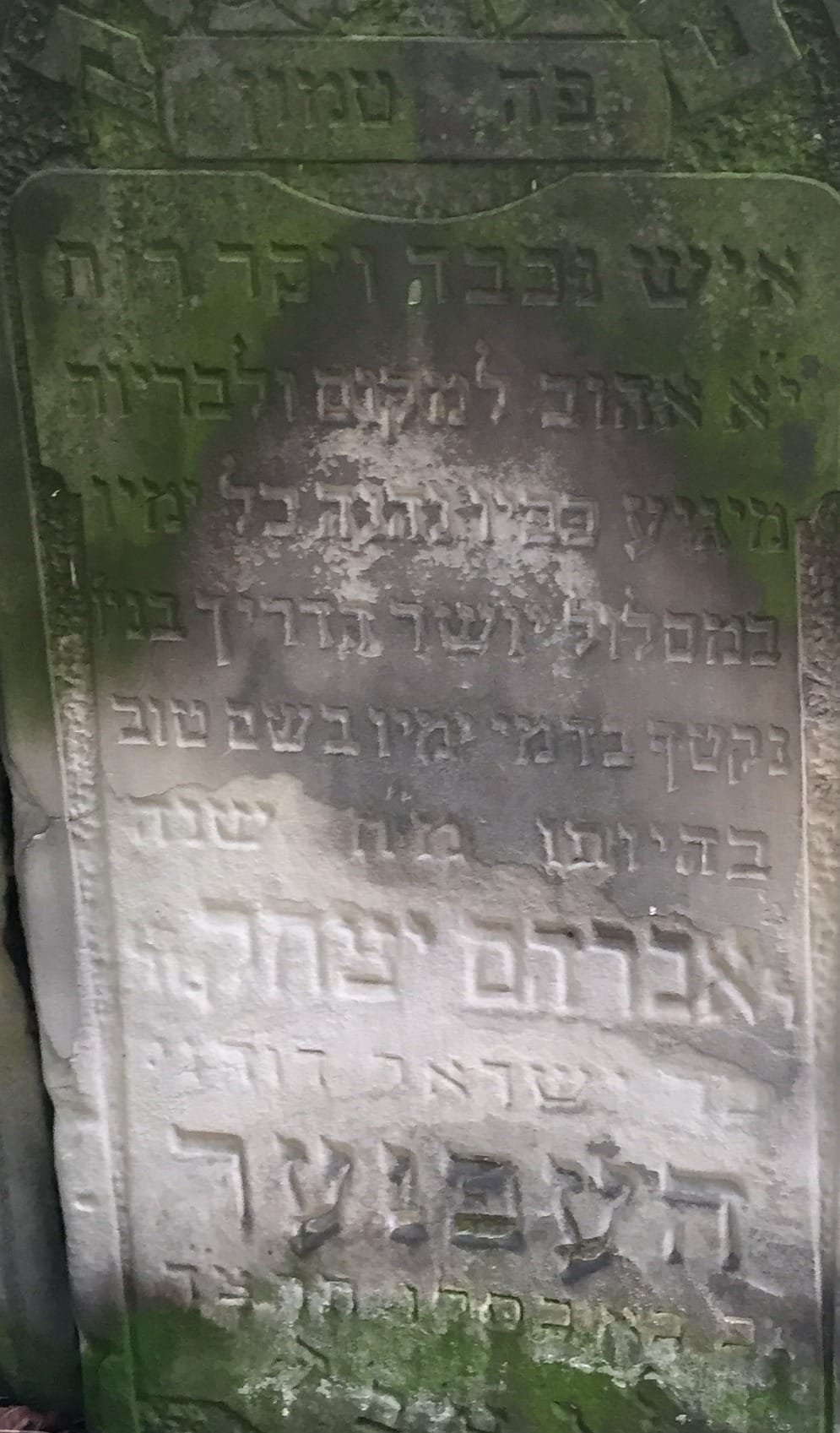
Everything documented about Avraham Yitzhak begins with this stone. It gives his name, his father's name, his priestly descent, the date of death — and, in a damaged line, his age.
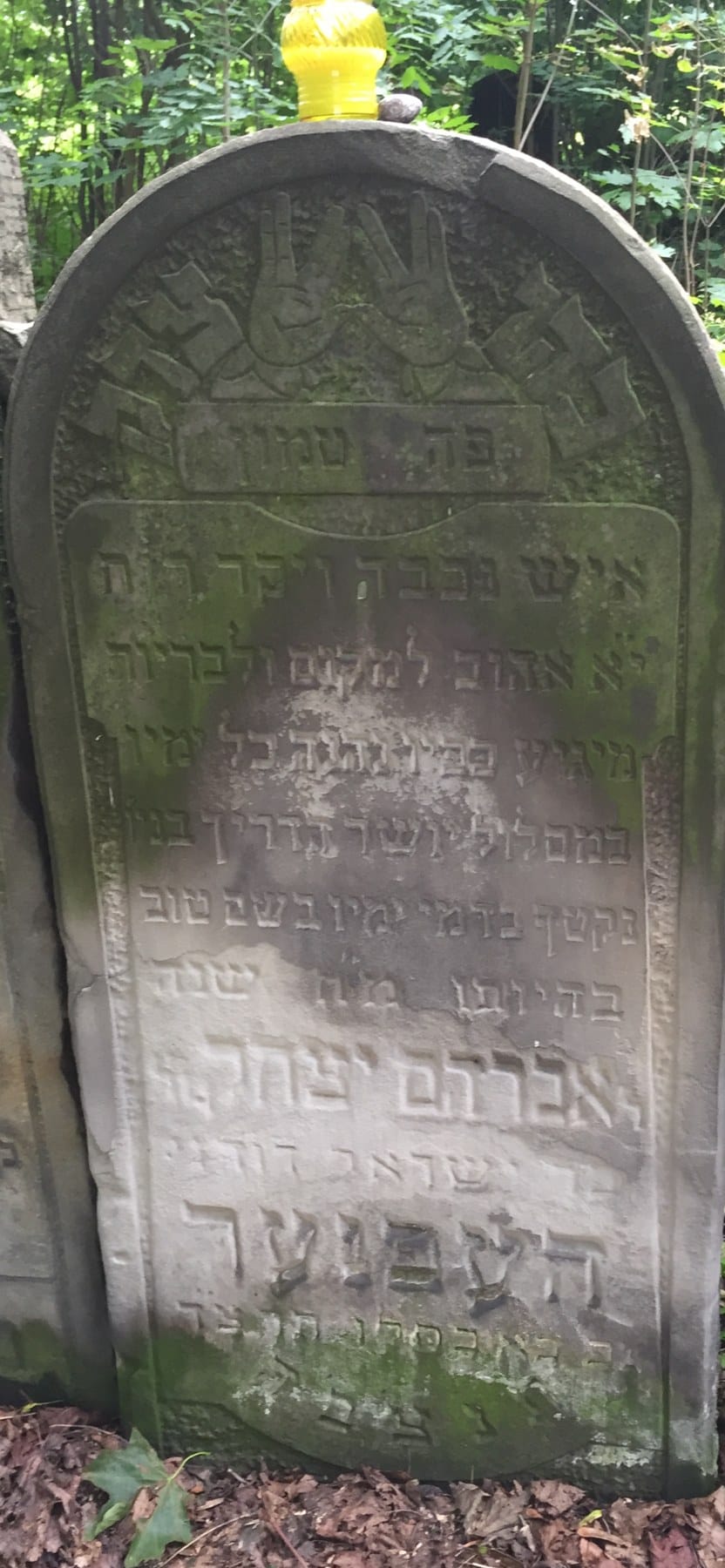
השם הוא אברהם יצחק העפנער, והוא מתואר ככהן צדק, כלומר כהן. שם אביו הוא ישראל דוד. תאריך הפטירה מתאים ל־9 בדצמבר 1933. נוסח המצבה מציין שנפטר בדמי ימיו. באזור הגיל האבן פגועה, ולכן הקריאה היא כנראה מ״ח, 48, או מ״ה, 45.
| Name in database | Hefner, Avraham Yitzhak |
|---|---|
| Father | Israel David |
| Date of death | 9 December 1933 |
| Cemetery | Jewish Cemetery, Okopowa Street, Warsaw |
| Location | Sector 73, row 30, grave 30 |
| Symbols | Priestly hands; described as כהן צדק, the usual honorific for a Kohen |
Strong candidate for Avraham Yitzhak's father
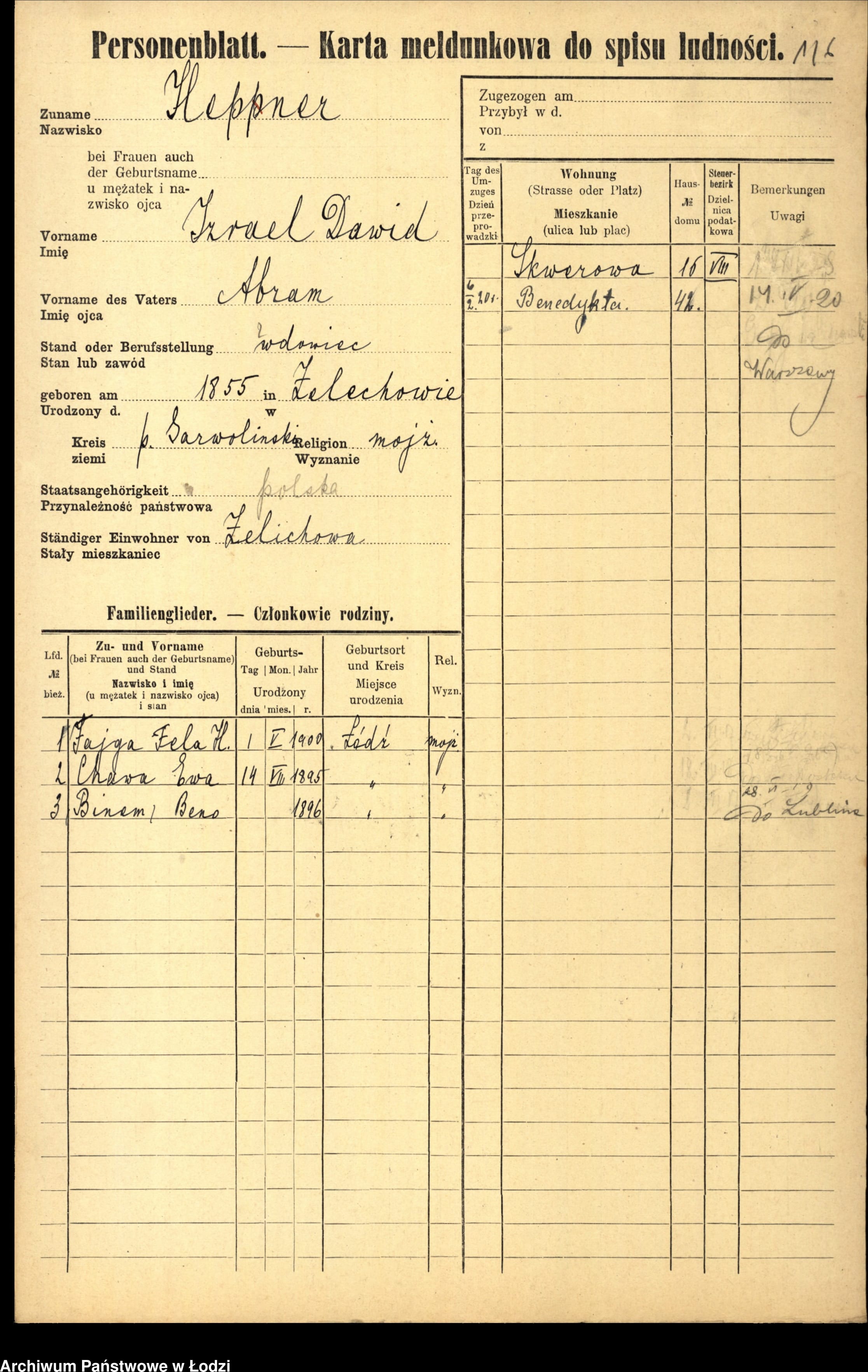
The Łódź population register compiled under German occupation in 1916–1921 holds a card for an Izrael Dawid Hepner whose name, generation, home town and later move to Warsaw all fit the father named on the gravestone. The volume (Henkel – Herc) was read in full; the cards that bear on the family are reproduced below. Next to every document, a code links to the source list and a scan link opens the exact page in the archive's viewer.
Spis ludności Łodzi, 1916–1921 · volume Henkel – Herc · Archiwum Państwowe w Łodzi · fonds Akta miasta Łodzi · 39/221/0/4.12/24657 · 314 scans · Szukaj w Archiwach, unit 6209045 A1·unit 6209045
| Nazwisko · surname | Heppner — written with two p's on the card; the archive's index normalises it to Hepner |
|---|---|
| Imię · given names | Izrael Dawid |
| Imię ojca · father | Abram |
| Stan lub zawód · status | wdowiec — widower |
| Urodzony · born | 1855 w Żelechowie — in Żelechów |
| Ziemi · county | p. Garwoliński — Garwolin county |
| Wyznanie · religion | mojż. — Mosaic (Jewish) |
| Przynależność państwowa | polska — Polish |
| Stały mieszkaniec · permanent resident of | Żelechowa — Żelechów |
| Mieszkanie · address in Łódź | Skwerowa 16, district VIII; a later line reads Benedykta 42 |
| Uwagi · pencil note | „… VI 20 … do Warszawy” — to Warsaw, June 1920 (day partly legible) |
| Name | Born | Place | Family knowledge |
|---|---|---|---|
| Fajga Fela H. | 1 V 1900 | Łódź | Known as Fajga, a sister of Avraham Yitzhak |
| Chawa Ewa | 14 VII 1895 | Łódź | Known as Chawa / Ewa, a sister of Avraham Yitzhak |
| Binem, Beno | 1896 | Łódź | Known as Binem, a brother of Avraham Yitzhak |
Fajga, Chawa/Ewa and Binem are exactly the names the family knows as the siblings of Avraham Yitzhak — Eli Gafner, Majer's son, found this card independently on 7 September 2026 and made the match. That is the strongest reason to read this as his father's household. Avraham Yitzhak himself is not on the card; as an adult of about thirty he would have had a card of his own. A pencil note beside the family rows reads „… do Lublina” (to Lublin) with a date like 28 II 19…; which member it refers to is not clear.
Family knowledge: Eli Gafner, son of Majer Gepner, message of 7 September 2026.
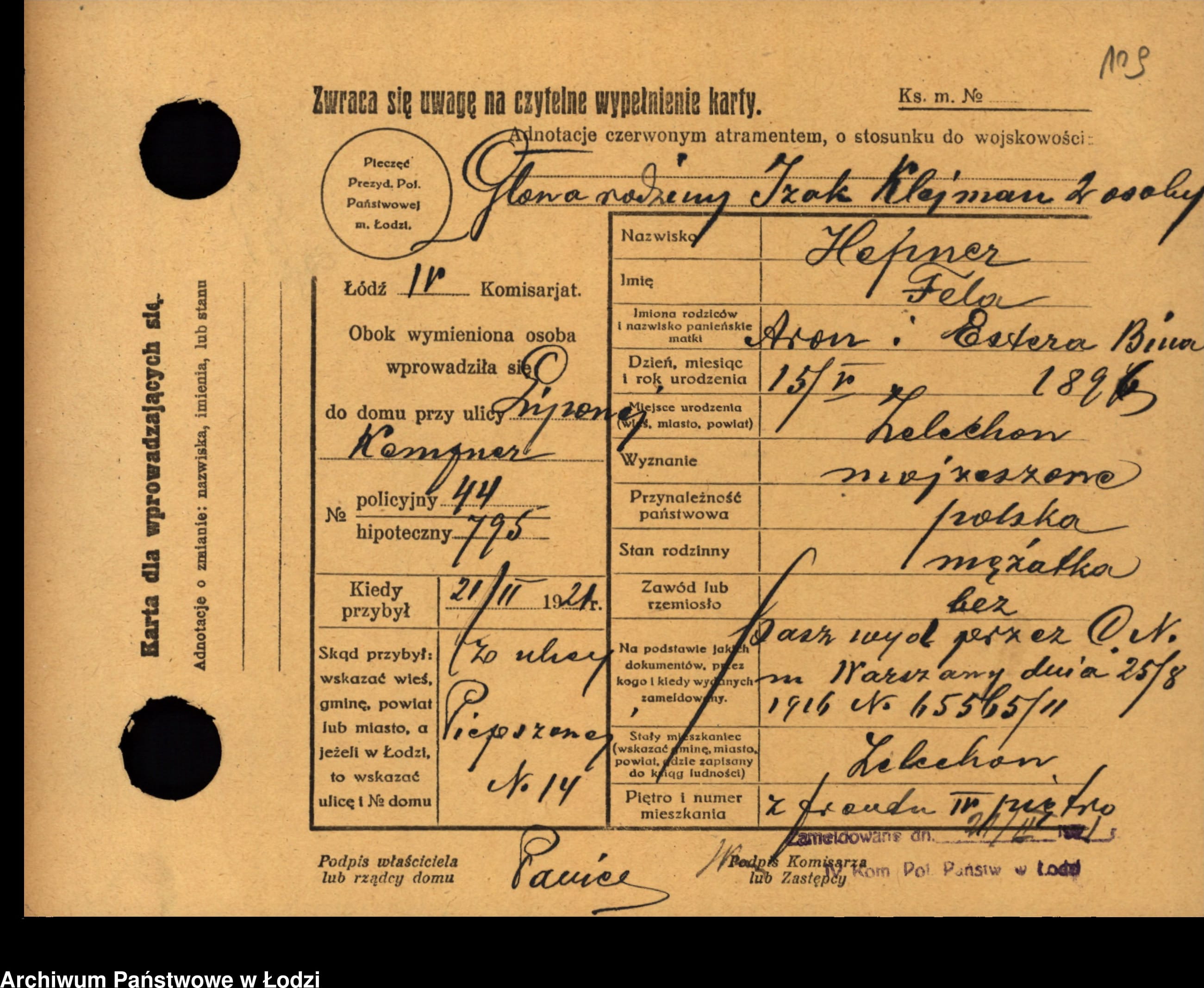
Before the 1916–1921 census cards, Łódź kept Russian-era ledgers of permanent residents by house number. The volume for houses 752–759 was downloaded in full on 8 September 2026 and read spread by spread. Three consecutive pages are the family — and they answer the questions the gravestone left open.
| Volume | Status |
|---|---|
| Księga ludności stałej m. Łodzi, houses 752–759APŁ 39/221/0/3.2.3/10109 · 563 cards on 287 spreadsA2·unit 6208176 | Pages 138–140 transcribed below. |
| Księga ludności stałej Łódź, circuit III, houses 741–794624 spreads · the earlier ledger for the same houses, indexed with Srul Dawid, Hendla, Abram Icek, Gitla, Estera and Sura SimaA3·unit 6207971 | Pages 143–144 transcribed below: the family's first Łódź entry, made in 1891. |
| Kniga postoânnago narodonaselenìâ (Łódź), 1897–1902570 spreads · indexed with Symcha Binem and ChawaA4·unit 6207986 | Read in full on 8 September 2026. One page, 568, transcribed below; no other Hepner or Gepner in the book. |
Russian-era entries. A red note across the first rows reads: „registered on the basis of a resettlement permit issued by the head of Garwolin district on 19 September 1891, no. 12428; see also no. 5090 of 1891”. The house column reads 754; the head's occupation is ткачъ — weaver.
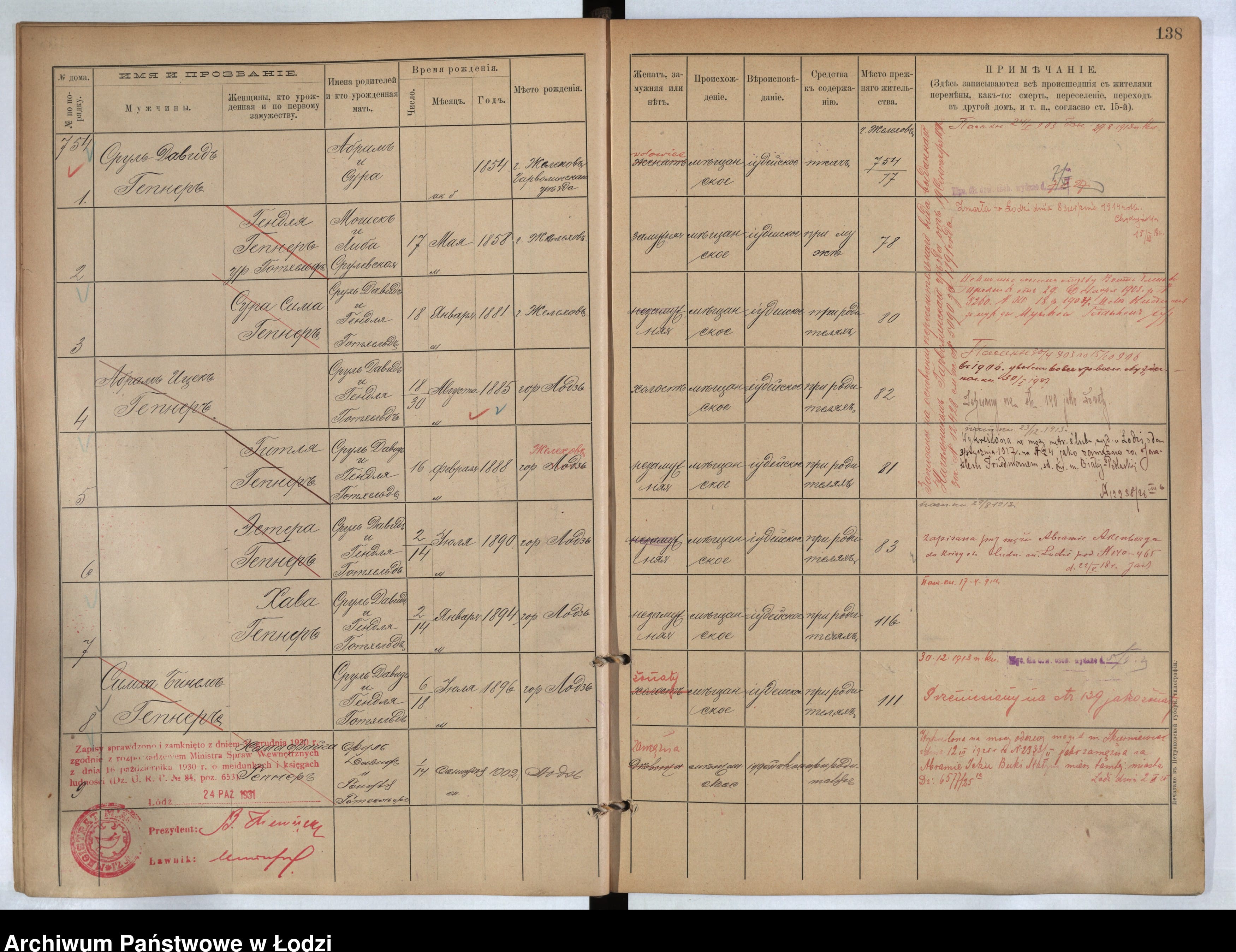
| № | Name | Parents | Born | Place | Status | Remarks |
|---|---|---|---|---|---|---|
| 1 | Сруль Давидъ Гепнеръ — Srul Dawid | Abram and Sura | 1854 | Żelechów, Garwolin district | married, later „wdowiec” (widower) in red | Passport booklets 24 I 1903 and 29 VIII 1913. Stamp: extract for an identity card issued 3 III 1927 (date partly legible) — alive in 1927. |
| 2 | Гендля Гепнеръ ур. Готгельдъ — Hendla née Gottheld | Moszek and Liba | 17 May 1858 | Żelechów | married, with her husband | „Zmarła w Łodzi dnia 8 sierpnia 1914 roku” — died in Łódź 8 August 1914. |
| 3 | Сура Сима — Sura Sima | Srul Dawid and Hendla Gottheld | 18 January 1881 | Żelechów | unmarried, with parents | Struck off on a gmina wójt's notice of 29 XII 1903, no. 3260; married (the husband's name is only partly legible, possibly Goldman). |
| 4 | Абрамъ Ицекъ Гепнеръ — Abram Icek | Srul Dawid and Hendla Gottheld | 18 / 30 August 1885 | Łódź | bachelor, with parents | Passport booklet 30 IV 1903 to 15 X 1906; in 1906 released entirely from military service; 30 I 1907. „Dopisany na str. 140 jako żonaty” — entered on page 140 as married. |
| 5 | Гитля — Gitla | Srul Dawid and Hendla Gottheld | 16 February 1888 | Łódź (a red correction reads Żelechów) | unmarried, with parents | Passport booklet 23 XII 1913. Struck off on the marriage record issued in Łódź 3 I 1917, no. 24, as married to Jankiel Friedman of Biała Podlaska. |
| 6 | Эстера — Estera | Srul Dawid and Hendla Gottheld | 2 / 14 July 1890 | Łódź | unmarried, with parents | Passport booklet 29 VIII 1913. Registered with her husband Abram Aksel[berg] in the Łódź book no. 140-465, 22 V 1918. |
| 7 | Хава — Chawa | Srul Dawid and Hendla Gottheld | 2 / 14 January 1894 | Łódź | unmarried, with parents | Passport booklet 17 IV 1914. |
| 8 | Симха Бинемъ — Symcha Binem | Srul Dawid and Hendla Gottheld | 6 / 18 July 1896 | Łódź | bachelor, later „żonaty” in red | Passport booklet 30 XII 1913. „Przeniesiony na str. 139 jako żonaty” — moved to page 139 as married. |
| 9 | Хана Файга — Chana Fajga | Srul Dawid and Hendla Gottheld | 1 / 14 September 1902 | Łódź | unmarried, with parents | Struck off on the notice of the Skierniewice magistrate of 12 III 1925, no. 2333/II, as married to Abram Icek Buk[…], resident of that town. |
Polish-era entries for the same house. Every child was born in the village of Łazy, gmina Falenty, Warsaw county — the Łazy the family remembers. The family re-registered in Łódź at the end of 1923.
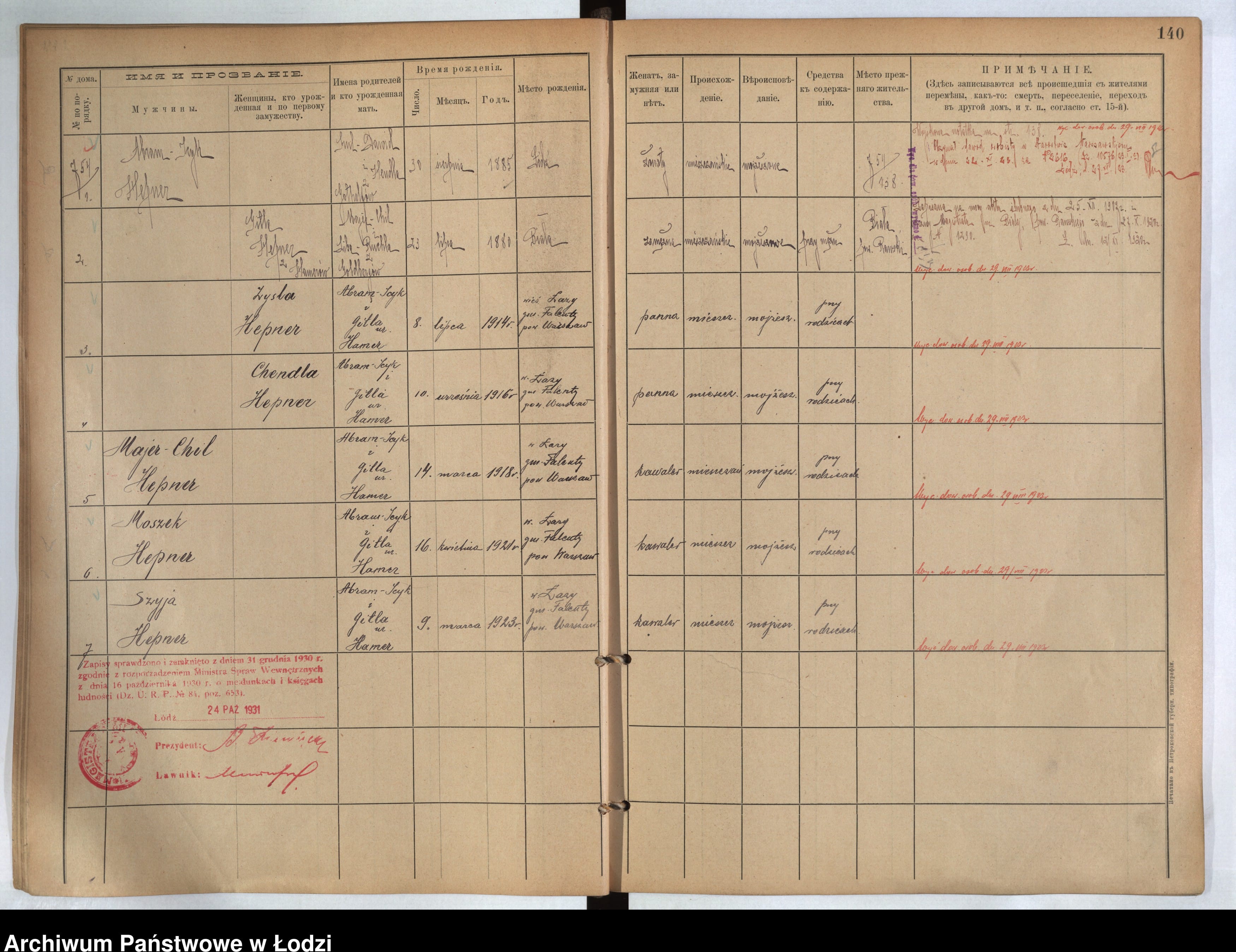
| № | Name | Parents | Born | Place | Status | Remarks |
|---|---|---|---|---|---|---|
| 1 | Abram-Icyk Hepner | Srul-Dawid and Hendla née Gottheld | 30 August 1885 | Łódź | married, mieszczańskie, mojżeszowe | „Wojskowa notatka na str. 138.” Received an identity card at the Warsaw county Starostwo on 22 XI 1923, no. 2616 (Dz. 10576/23); Łódź, 27 XII 1923. Extract for an identity card 29 VIII 1924. |
| 2 | Gitla Hepner z Hamerów — née Hamer | Majer-Chil and Liba-Ruchla née Goldberg | 23 July 1880 | Biała, Rawa county | married, with her husband; previous residence Biała, pow. Rawski | Registered on the marriage act of 25 XII 1913 and a certificate of the Biała magistrate of 27 X 1920, no. 1290; Łódź, 15 XI 1920. |
| 3 | Zysla Hepner | Abram-Icyk and Gitla née Hamer | 8 July 1914 | wieś Łazy, gm. Falenty, pow. warszawski | unmarried, with parents | Extract for an identity card 29 VIII 1924. |
| 4 | Chendla Hepner — Henia | Abram-Icyk and Gitla née Hamer | 10 September 1916 | Łazy, gm. Falenty | unmarried, with parents | |
| 5 | Majer-Chil Hepner — Majer | Abram-Icyk and Gitla née Hamer | 14 March 1918 | Łazy, gm. Falenty | bachelor, with parents | The 1948 passport gives 5 May 1918 and Łódź. |
| 6 | Moszek Hepner — Moshe | Abram-Icyk and Gitla née Hamer | 16 April 1921 | Łazy, gm. Falenty | bachelor, with parents | |
| 7 | Szyja Hepner — Yehoshua | Abram-Icyk and Gitla née Hamer | 9 March 1923 | Łazy, gm. Falenty | bachelor, with parents |
Binem's branch, which explains the „do Lublina” pencil note on his father's 1916–1921 card.
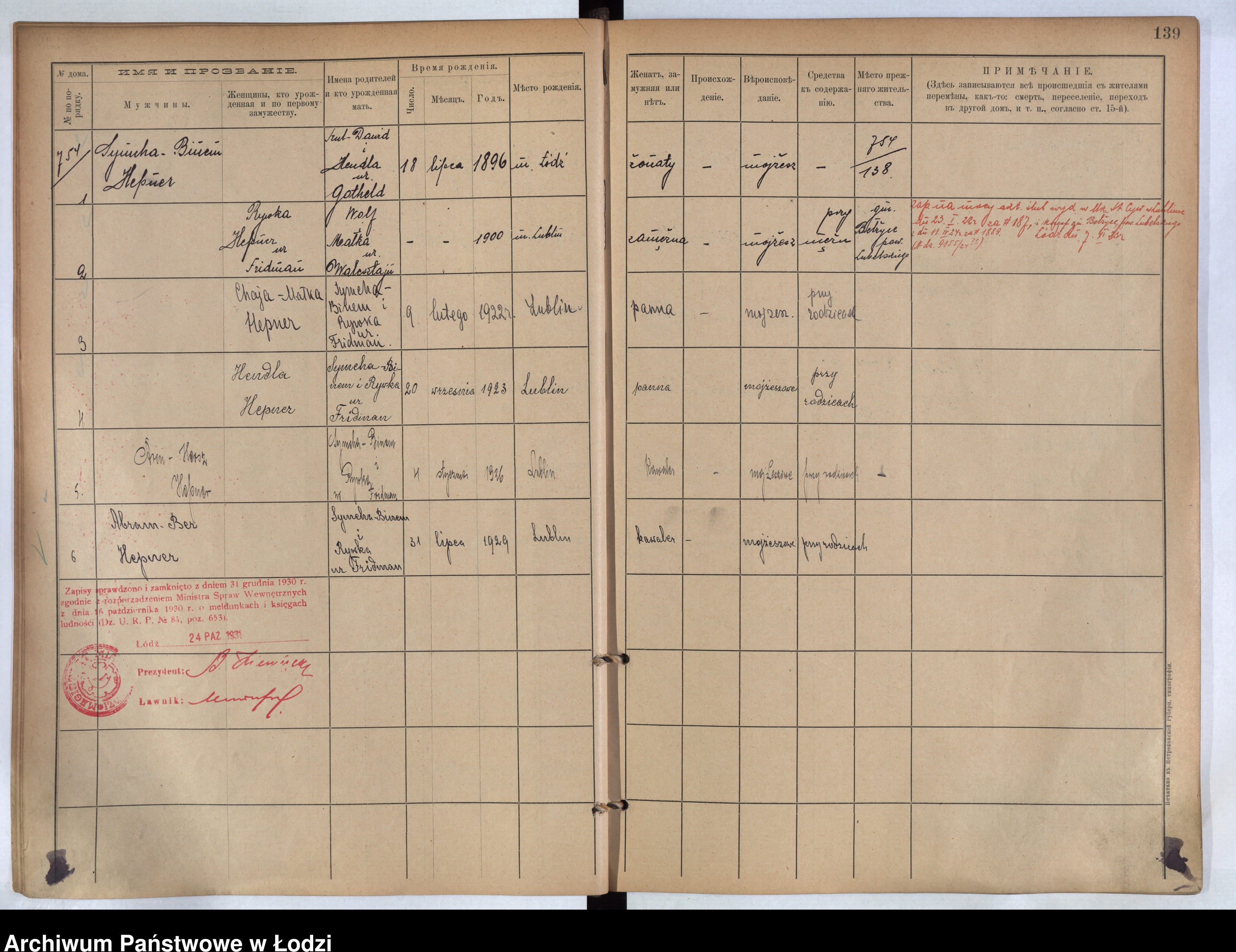
| № | Name | Parents | Born | Place | Status | Remarks |
|---|---|---|---|---|---|---|
| 1 | Symcha-Binem Hepner | Srul-Dawid and Hendla née Gotheld | 18 July 1896 | Łódź | married, mojżeszowe; from page 138 | |
| 2 | Ryfka Hepner z Frydmanów — née Frydman | Wolf and Małka née Walensztajn | 1900 | Lublin | married, with her husband; previous residence gmina Bełżyce, Lublin county | Registered on the marriage act issued by the civil registry in Lublin, 23 I 1922, no. 187, and a Bełżyce certificate of 11 II 1924, no. 1889; Łódź, 7 VI 1924. |
| 3 | Chaja-Małka Hepner | Symcha-Binem and Ryfka née Frydman | 9 February 1922 | Lublin | unmarried, with parents | |
| 4 | Hendla Hepner | Symcha-Binem and Ryfka née Frydman | 20 September 1923 | Lublin | unmarried, with parents | |
| 5 | Aron-Hersz Hepner | Symcha-Binem and Ryfka née Frydman | 4 January 1926 | Lublin | bachelor, with parents | |
| 6 | Abram-Ber Hepner | Symcha-Binem and Ryfka née Frydman | 31 July 1929 | Lublin | bachelor, with parents |
The circuit III ledger for houses 741–794, on Polish-language forms of the 1860s with Russian entries. The family was written in on the resettlement permit of 19 September 1891; each row was later stamped „записано въ новую книгу № 754 стр. 138” — entered in the new book, house 754, page 138.
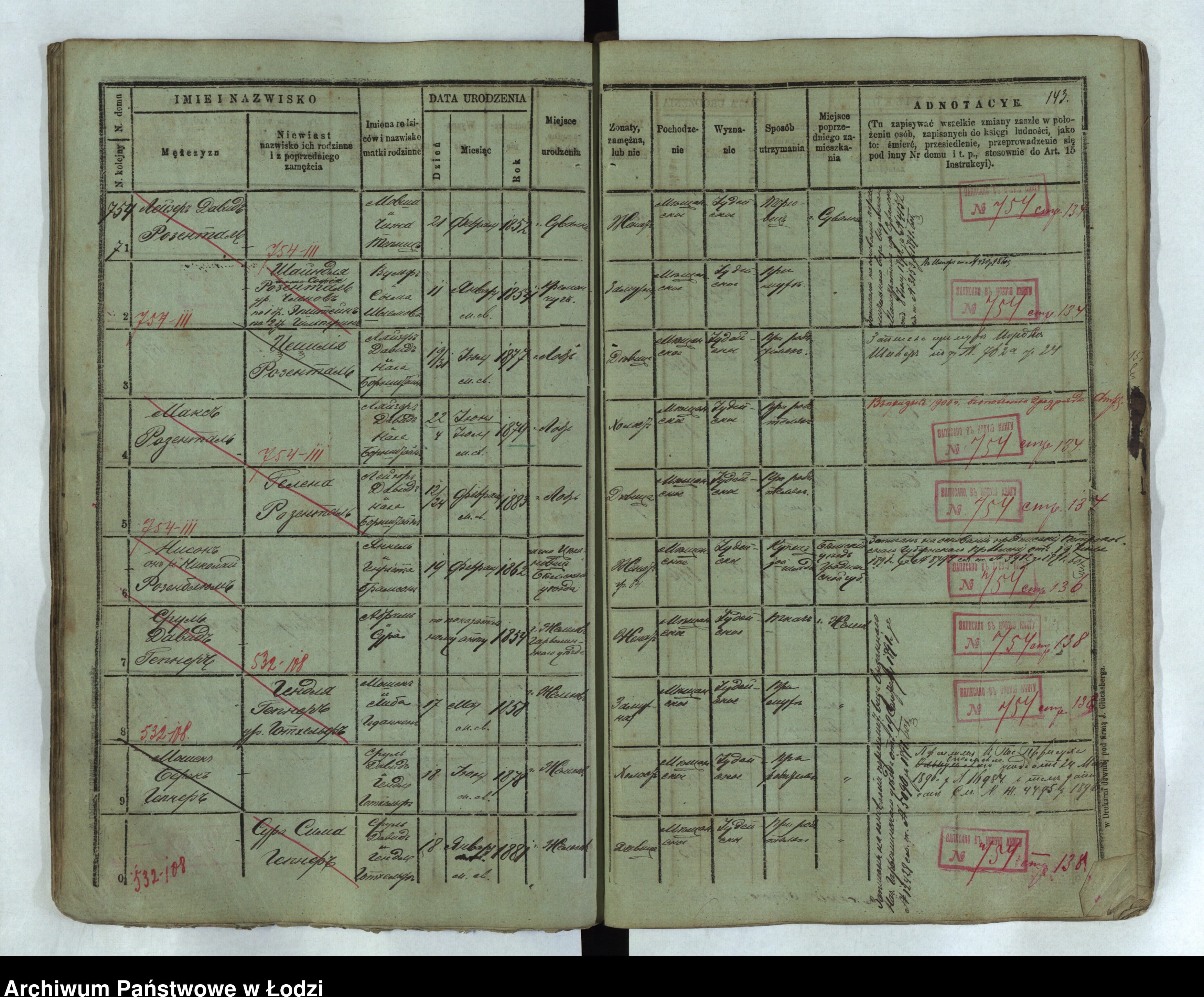
| № | Name | Parents | Born | Place | Status | Remarks |
|---|---|---|---|---|---|---|
| 7 | Сруль Давидъ Гепнеръ — Srul Dawid | Abram and Sura | 1854, „according to the birth act” | Żelechów, Garwolin district | married, townsman, Jewish, weaver; previous residence Żelechów | Permit of 19 IX 1891, no. 12428 (see also no. 5090 of 1891). Entered in the new book, 754 p. 138. |
| 8 | Гендля Гепнеръ ур. Готгельдъ — Hendla née Gottheld | Moszek and Liba | 17 May 1858 | Żelechów | married, with her husband | Entered in the new book, 754 p. 138. |
| 9 | Мошекъ Берекъ Гепнеръ — Moszek Berek | Srul Dawid and Hendla Gottheld | 18 June 1878 | Żelechów | bachelor, with parents | Transferred out on 24 May 1896, no. 16984 (destination partly legible). He is the Mojżesz Hepner, son of Izrael, born 1877 Żelechów, of the 1916–1921 card — Avraham Yitzhak's elder brother. |
| 10 | Сура Сима — Sura Sima | Srul Dawid and Hendla Gottheld | 18 January 1881 | Żelechów | unmarried, with parents | Entered in the new book, 754 p. 138. |
The three younger children of the 1880s. Note that Gitla was born in Żelechów in 1888, between two Łódź births — the family kept moving between the two towns.
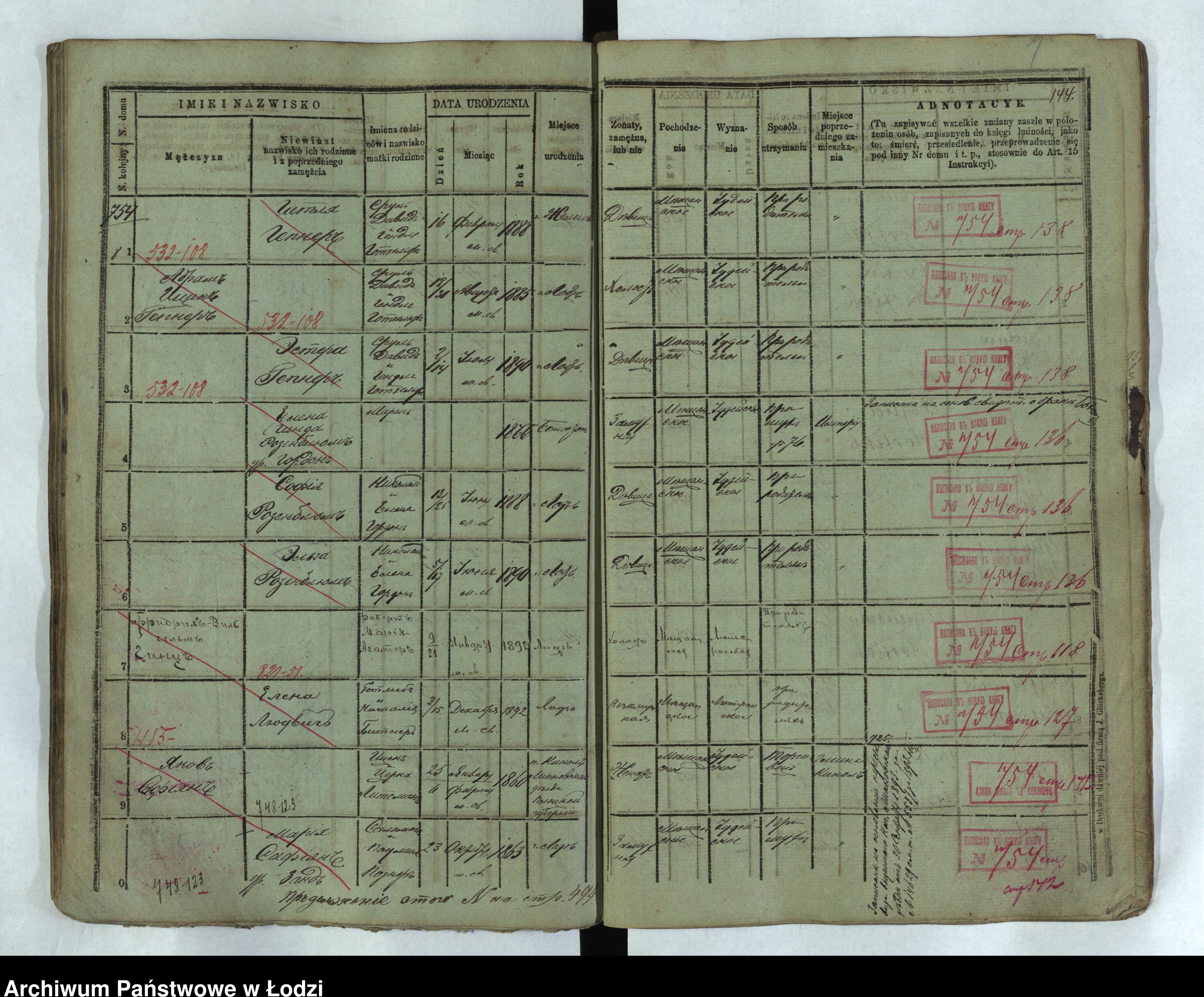
| № | Name | Parents | Born | Place | Status | Remarks |
|---|---|---|---|---|---|---|
| 1 | Гитля — Gitla | Srul Dawid and Hendla Gottheld | 16 February 1888 | Żelechów | unmarried, with parents | Entered in the new book, 754 p. 138. |
| 2 | Абрамъ Ицекъ Гепнеръ — Abram Icek | Srul Dawid and Hendla Gottheld | 18 / 30 August 1885 | Łódź | bachelor, with parents | Entered in the new book, 754 p. 138. |
| 3 | Эстера — Estera | Srul Dawid and Hendla Gottheld | 2 / 14 July 1890 | Łódź | unmarried, with parents | Entered in the new book, 754 p. 138. |
Transcribed from the scans on 8 September 2026. Russian-era names are given in the ledger's Cyrillic with a Polish equivalent; a few remarks are only partly legible and are marked as such. The ledger writes the surname Гепнеръ in Russian and Hepner in Polish for the same people.
A supplementary sheet for house 754 in the 1897–1902 book, shared with two Lutheran families, Ludwig and Hinz. The two Gepner rows carry the red stamp „Записано въ новую книгу № 754, стр. 138” — entered in the new book, house 754, page 138 — which is exactly where they reappear. A red note at the foot records that the sheet was checked against the new book in 1903. Symcha Binem's row also carries a red cross-reference „532-108” that has not been resolved.
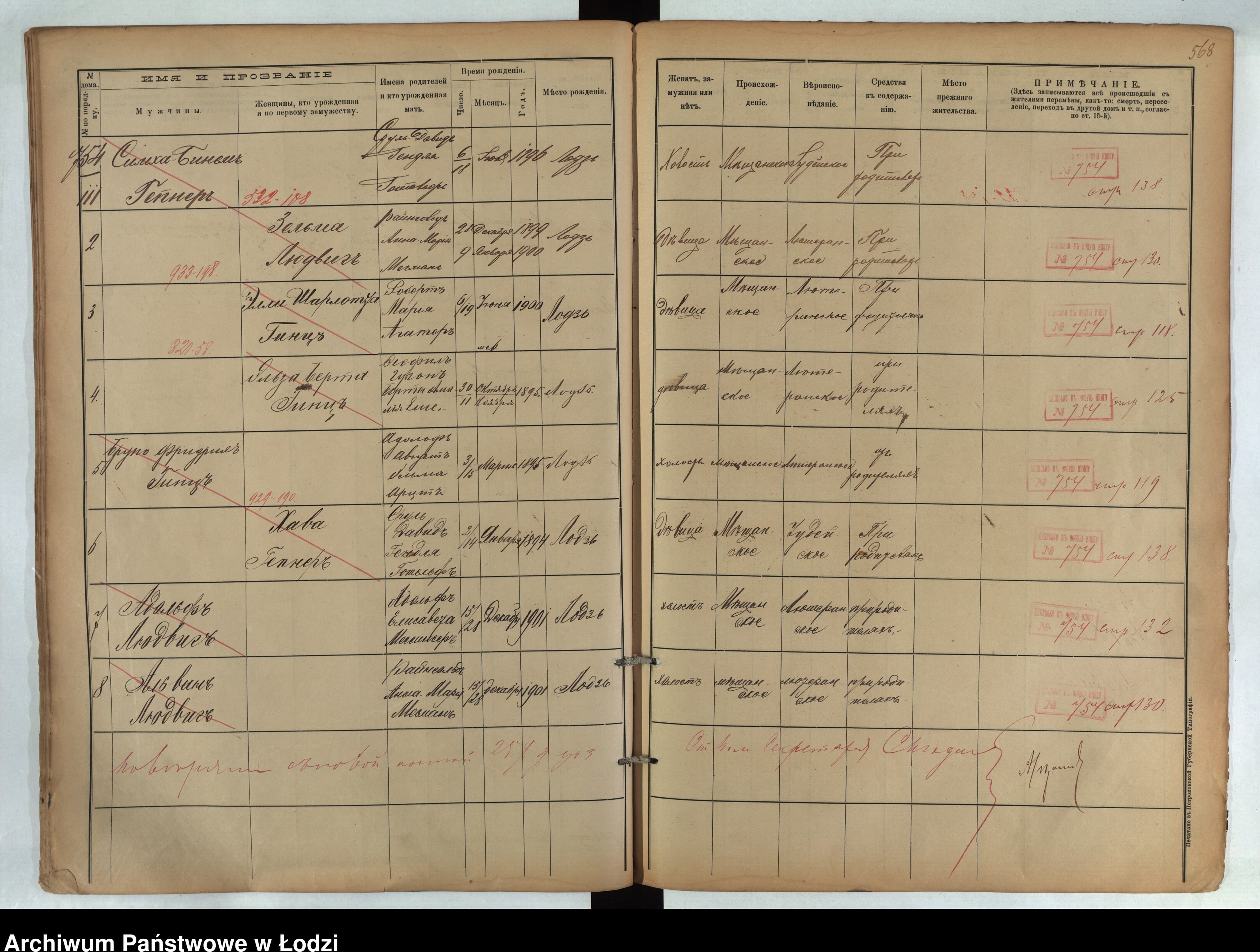
| № | Name | Parents | Born | Place | Status | Remarks |
|---|---|---|---|---|---|---|
| 1 | Симха Бинемъ Гепнеръ — Symcha Binem | Srul Dawid and Hendla Gottheld | 6 / 18 July 1896 | Łódź | bachelor, townsman (мѣщанское), Jewish, with parents | Red cross-reference „532-108”. Stamp: entered in the new book, house 754, page 138. |
| 6 | Хава Гепнеръ — Chawa | Srul Dawid and Hendla Gottheld | 2 / 14 January 1894 | Łódź | unmarried, townswoman, Jewish, with parents | Stamp: entered in the new book, house 754, page 138. |
The other 569 scans of the book were read name by name on 8 September 2026: no other Hepner or Gepner. Moszek Berek, whose transfer out of Łódź on 24 May 1896 is still unexplained, is not in it either — so the 1896 move took him outside these houses, and probably outside the city.
Row 4 of ledger page 138 carries three lines in red Russian script. They look administrative, and one of them has been read as though Avraham Yitzhak had served in the tsar's army — which would sit oddly with a Hasidic family. He did not serve. The line records the opposite: at his call-up he was let off altogether.
Пасспортн. 30/4 903 по 15/10 906
Passport booklet, 30 April 1903 to 15 October 1906 — a short-term internal passport, the kind issued to a man still liable for the draft.
въ 1906. уволенъ вовсе отъ военн. службы
In 1906, released altogether from military service — the statutory formula for a permanent exemption.
пас. кн. 30/1 1907
Passport book, 30 January 1907 — a fresh passport once the matter was settled.
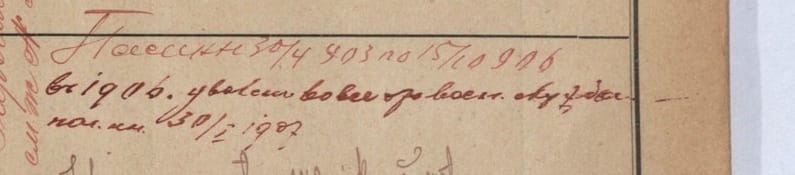
Under the conscription statute of 1874 one age group was called each year: the men who had turned twenty by 1 January of that year (article 11). Avraham Yitzhak was born on 30 August 1885, so he turned twenty in August 1905 and belonged to the levy of 1906. His passport ran out on 15 October 1906, in the middle of the autumn call-up, and the next one was issued three months later. The dates are the paperwork of a man going before the board and coming away free of it.
The statute uses „увольняются вовсе отъ службы” for men found wholly incapable, by illness or injury, of either combatant or non-combatant duty (article 32). „Вовсе” — altogether — is the point: not the reserve, not the second line, nothing. A man who had actually served would have been written into the reserve and given a certificate of duty performed, and the ledger would say so.
The other way out was the family exemption, granted in three classes to an only son or the only working son (article 45). But those men were not released; they were enrolled in the militia, the ополченіе, against a future war (article 154). The clerk wrote neither militia nor class, so the exemption here is the medical one: he was examined and found unfit. What the defect was, the ledger does not say.
Conscription was the thing observant Jewish families in the Russian Empire feared most: years in barracks meant no kosher food, no Sabbath, no study, and within living memory it had meant worse. Communities went to great lengths to keep their sons out, and the law bore down on them in return — a family whose son failed to appear was fined 300 roubles, and from 1878 a district short of Jewish recruits had to make the number up from Jews who were otherwise exempt. A release granted in full, on the record, was the best result such a family could get. There is no conflict here with the Kotzk tradition; if anything the note is a small piece of evidence for the world the family lived in.
Symcha Binem, born 1896, would have faced the levy of 1917, by which time Łódź was under German occupation and the Russian draft had gone; his row carries no military note at all. Moszek Berek, born 1878, was struck off the Łódź books in 1896 — his call-up year — and does not reappear in the city for twenty years. Where he went, and whether the two facts are connected, is one of the open questions.
What would add to this: the Piotrków Governorate military files (fonds 39/2, Rząd Gubernialny Piotrkowski, 1867–1918), which are unindexed and would have to be read by hand, and the Łódź call-up lists of 1906 if any survive outside the destroyed board records.
In the 1930s the Łódź city administration kept a running register of the identity cards it issued: name, birth date and place, date of issue, address and card number. The two surviving volumes for surnames Ch–Ł, 1936–1939 — 438 pages — were read page by page on 8 September 2026. Four rows carry the family name together with a birth date or place that can be checked; three more Hepners are set aside below.
| Card | Name | Born | Issued | Address | Status | Source |
|---|---|---|---|---|---|---|
| 1353 of the 1939 run | Hepner, Majer-Chil | 14 March 1918, Łazy, gmina Falenty, Warsaw county | 30 May 1939 | Gdańska 131 | Majer | A6·scan 205·unit 9645125 |
| 1388 of the 1938 run | Hepner, Moszek | 16 April 1921, Łazy, gmina Falenty, Warsaw county | 8 July 1938 | Gdańska 131 | Moshe | A6·scan 73·unit 9645125 |
| 52 of the 1936 run | Hepner, Motek-Aron | 19 July 1870, Żelechów | 10 January 1936 | Zawadzka 22 | Probable kin | A5·scan 6·unit 9645124 |
| 1518 of the 1938 run | Hepner, Symcha | 26 March 1898, Łódź | 20 July 1938 | Lutomierska 28 | Not Symcha Binem | A6·scan 79·unit 9645125 |



Searched in the gravestone database D1·record 20517 — Avraham Yitzhak Hepner, Okopowa 73/30/30
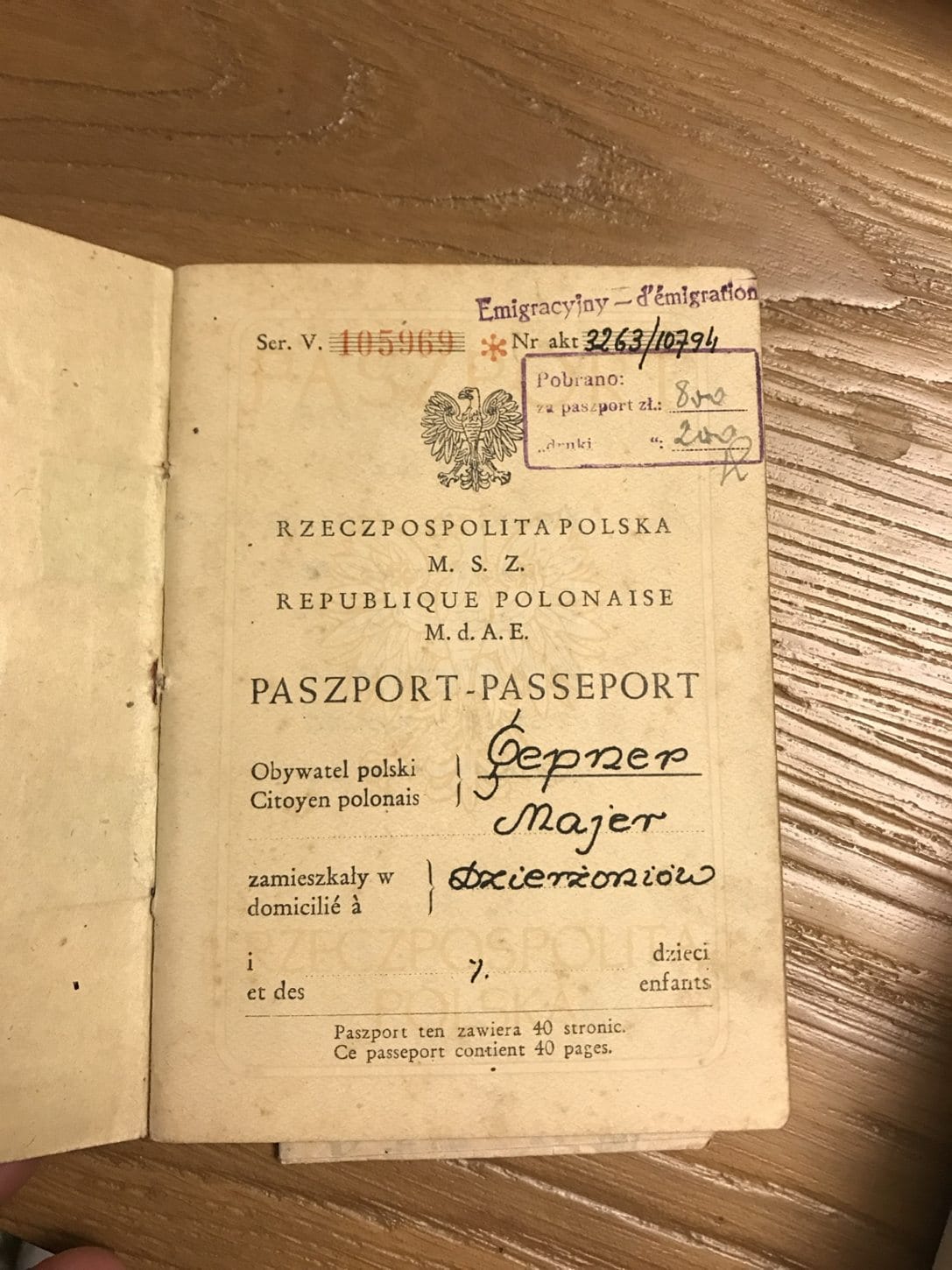
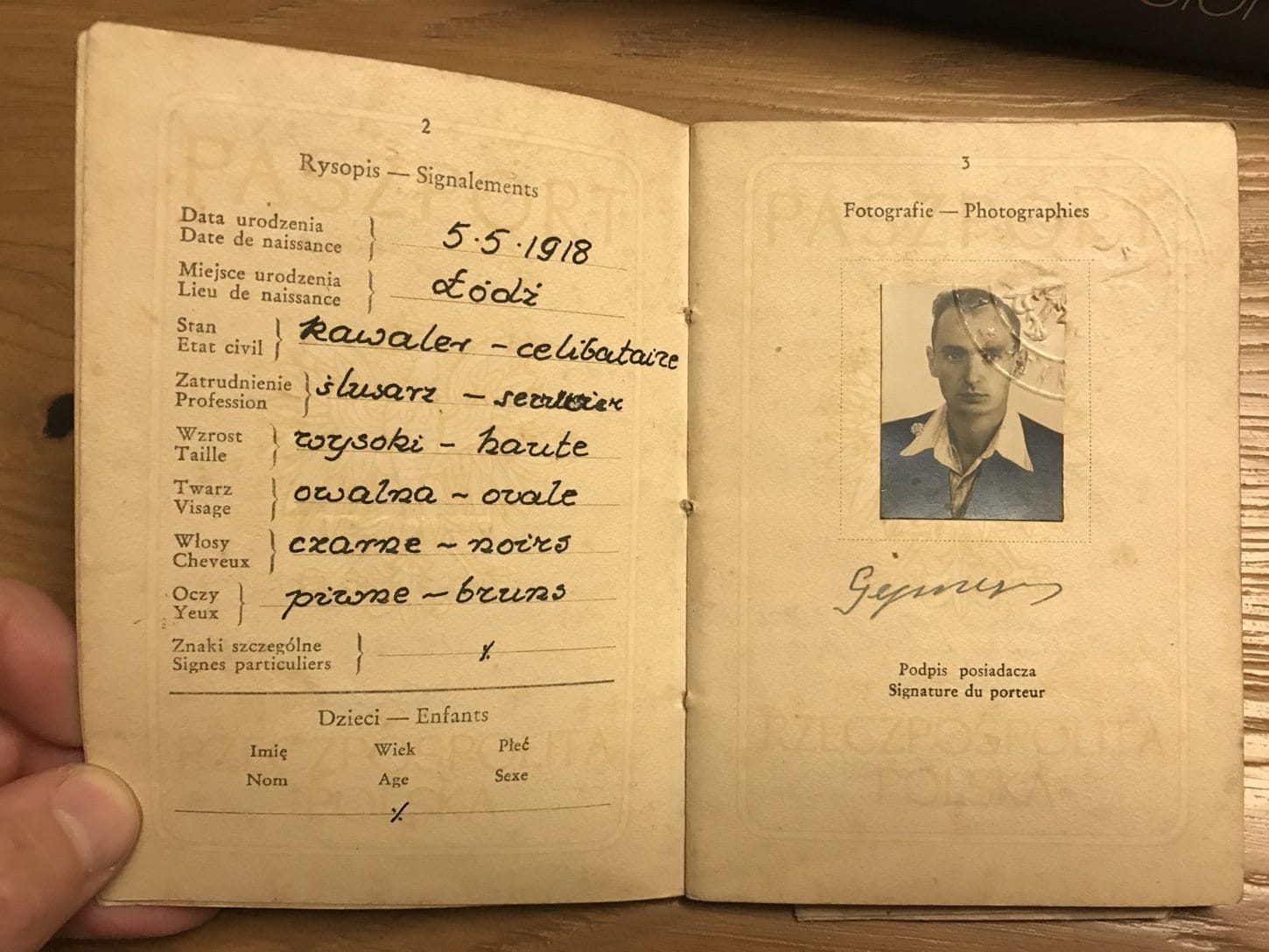
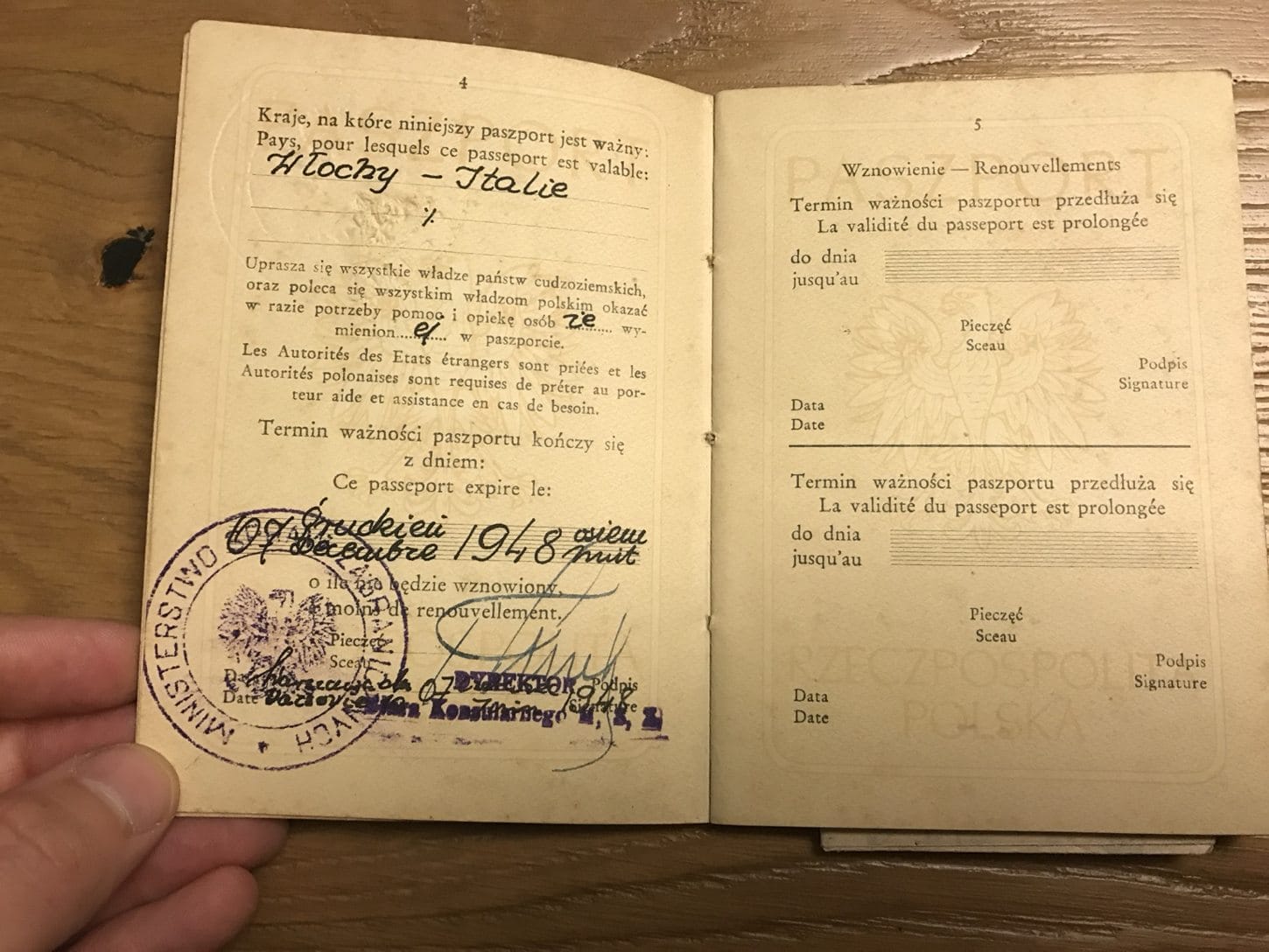
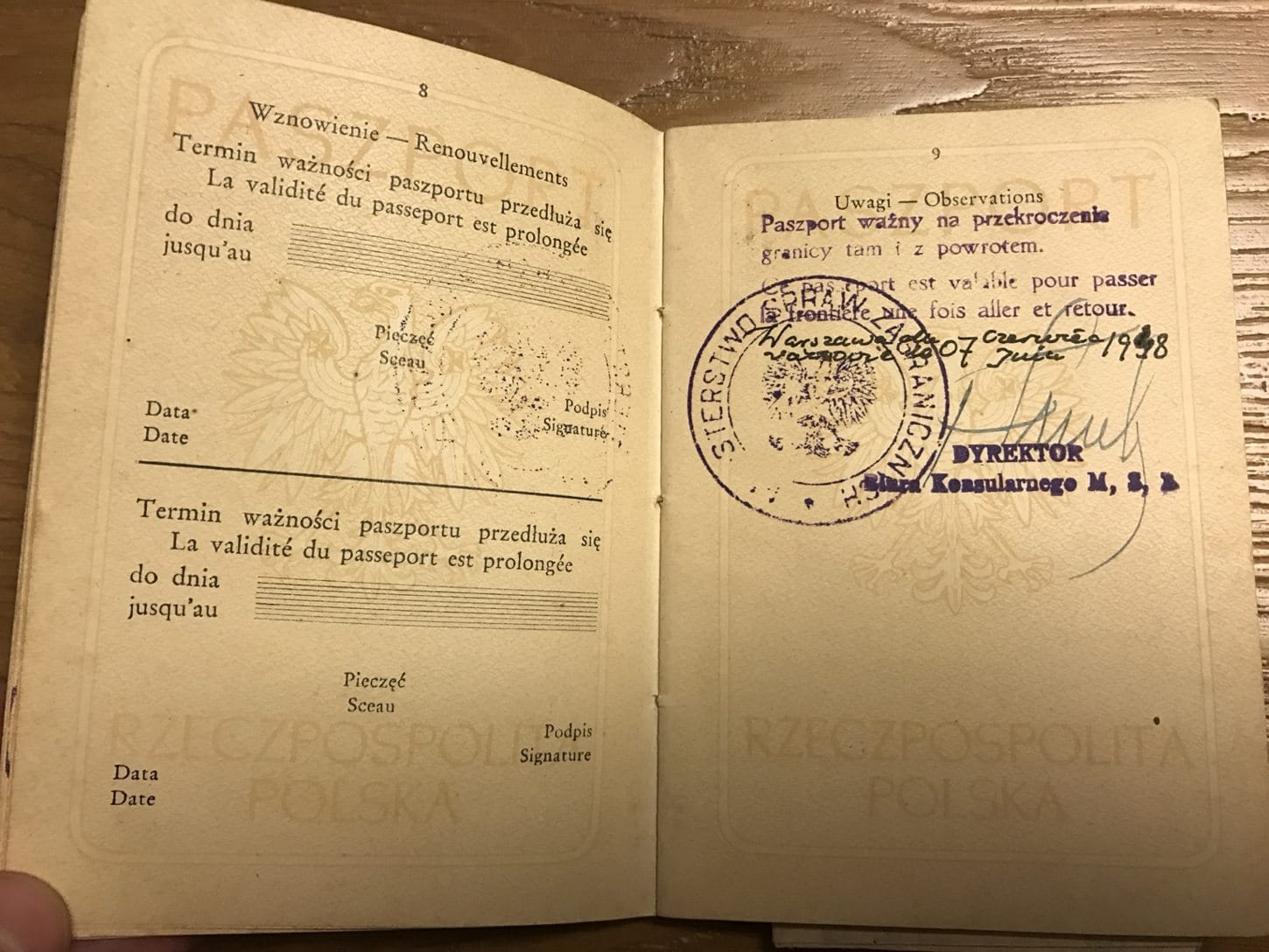
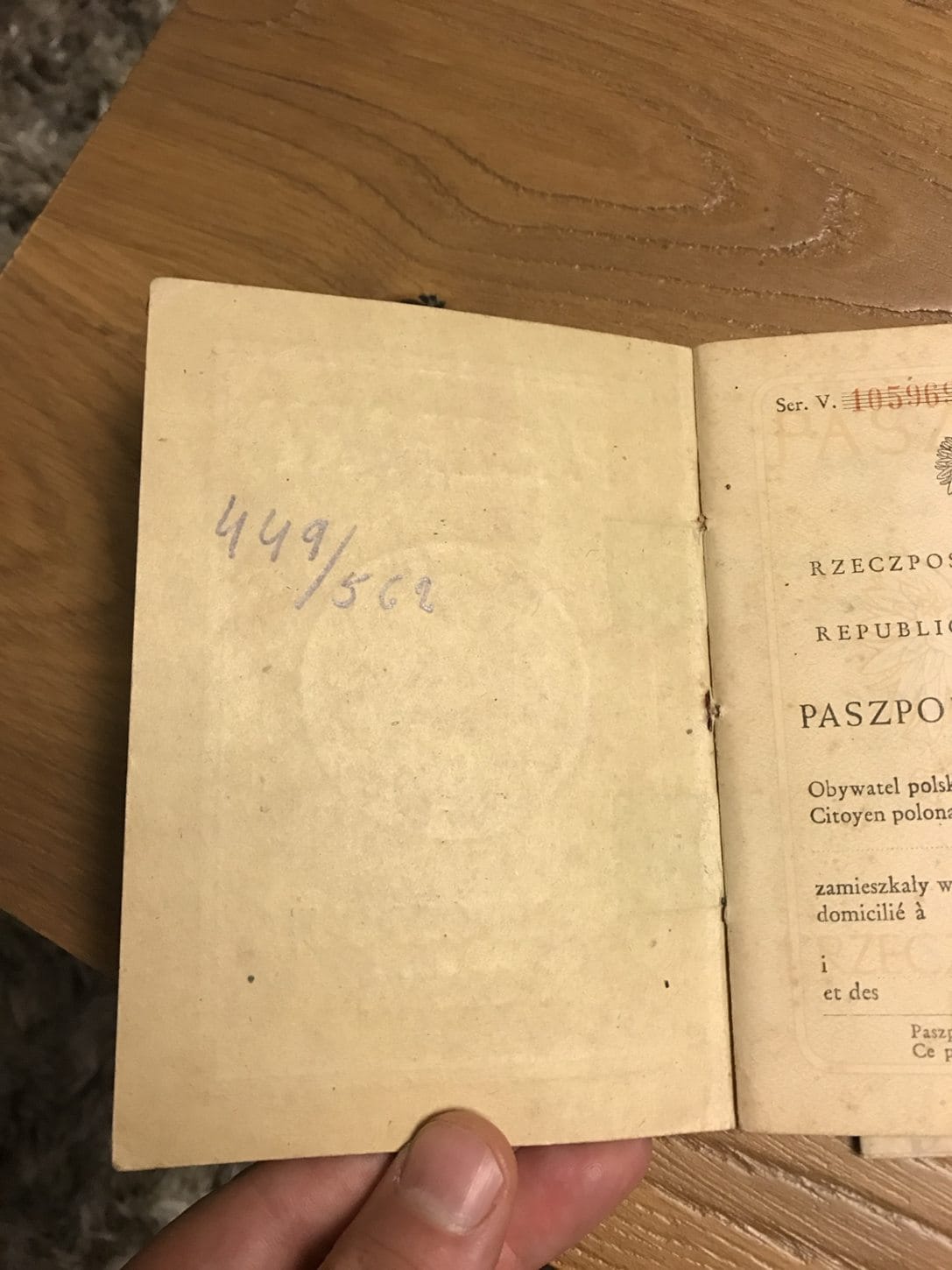
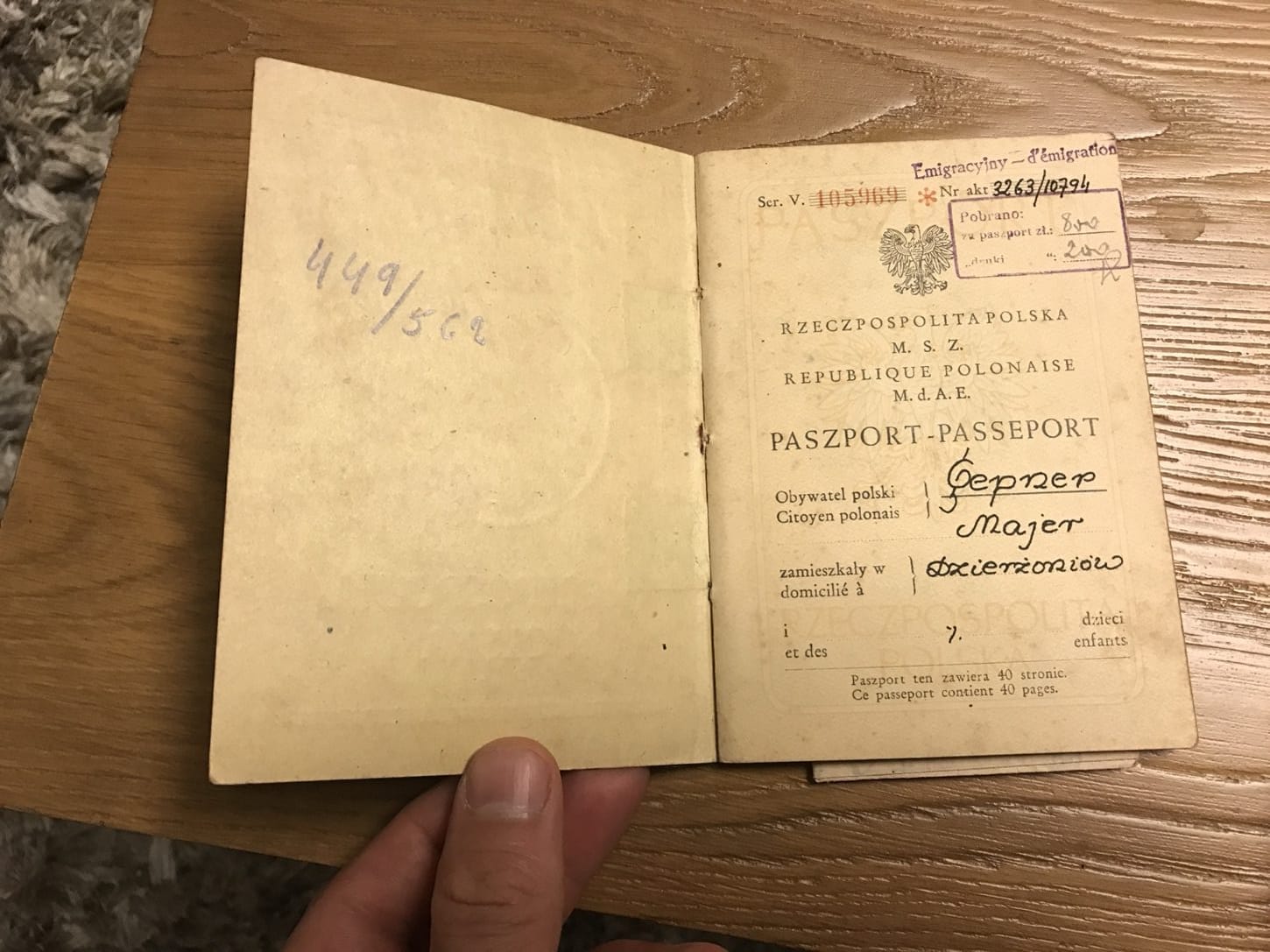
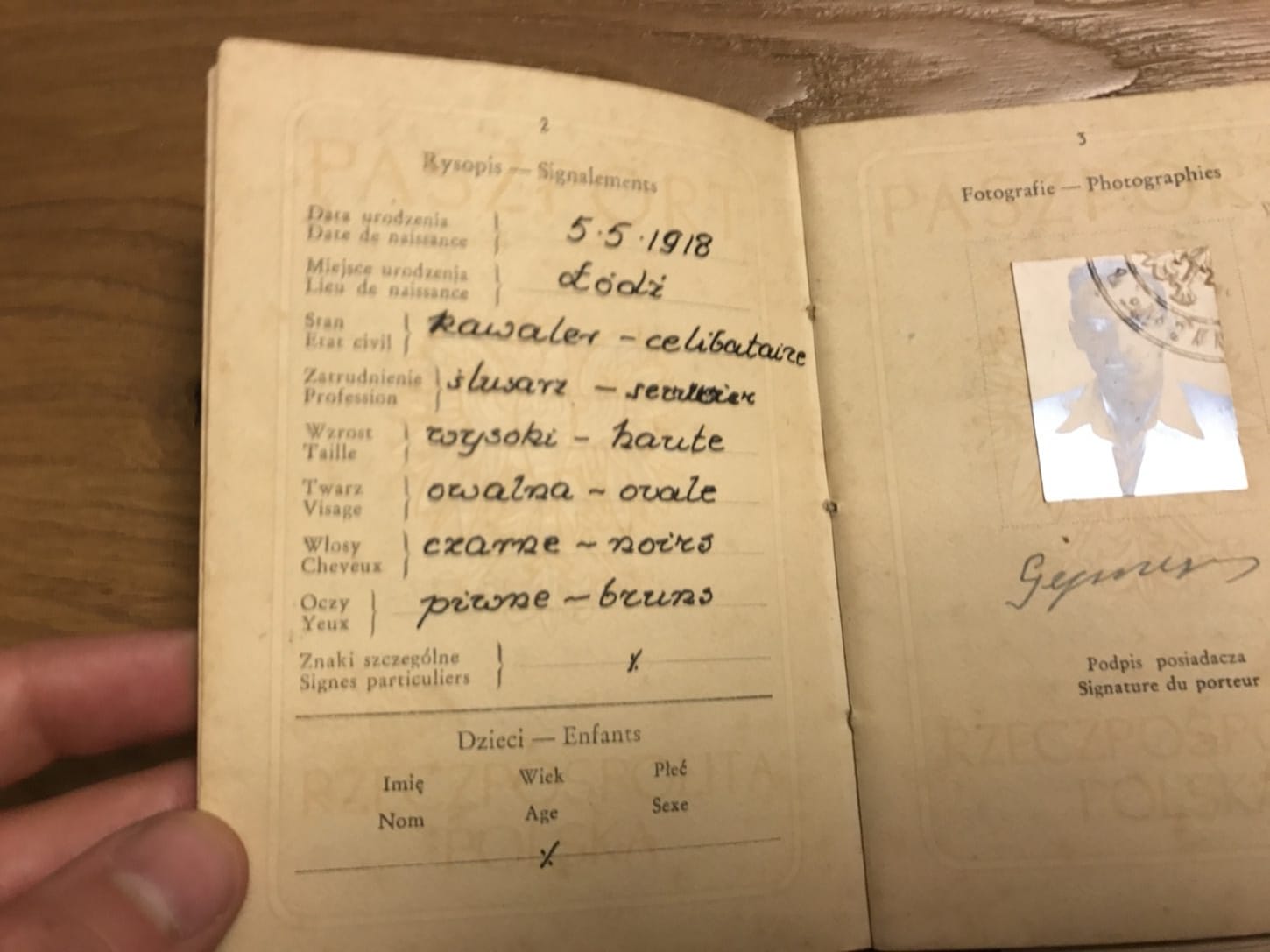
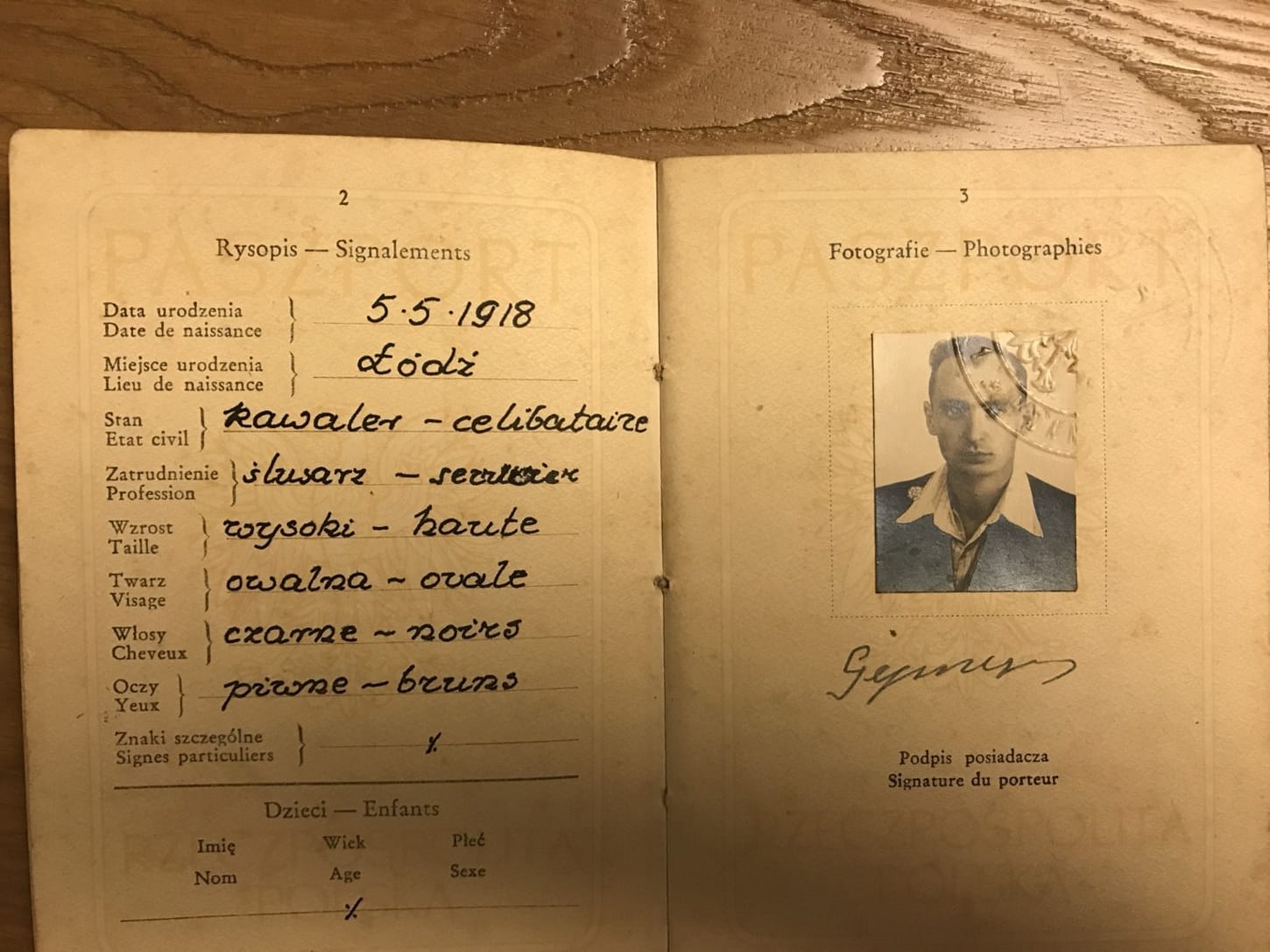
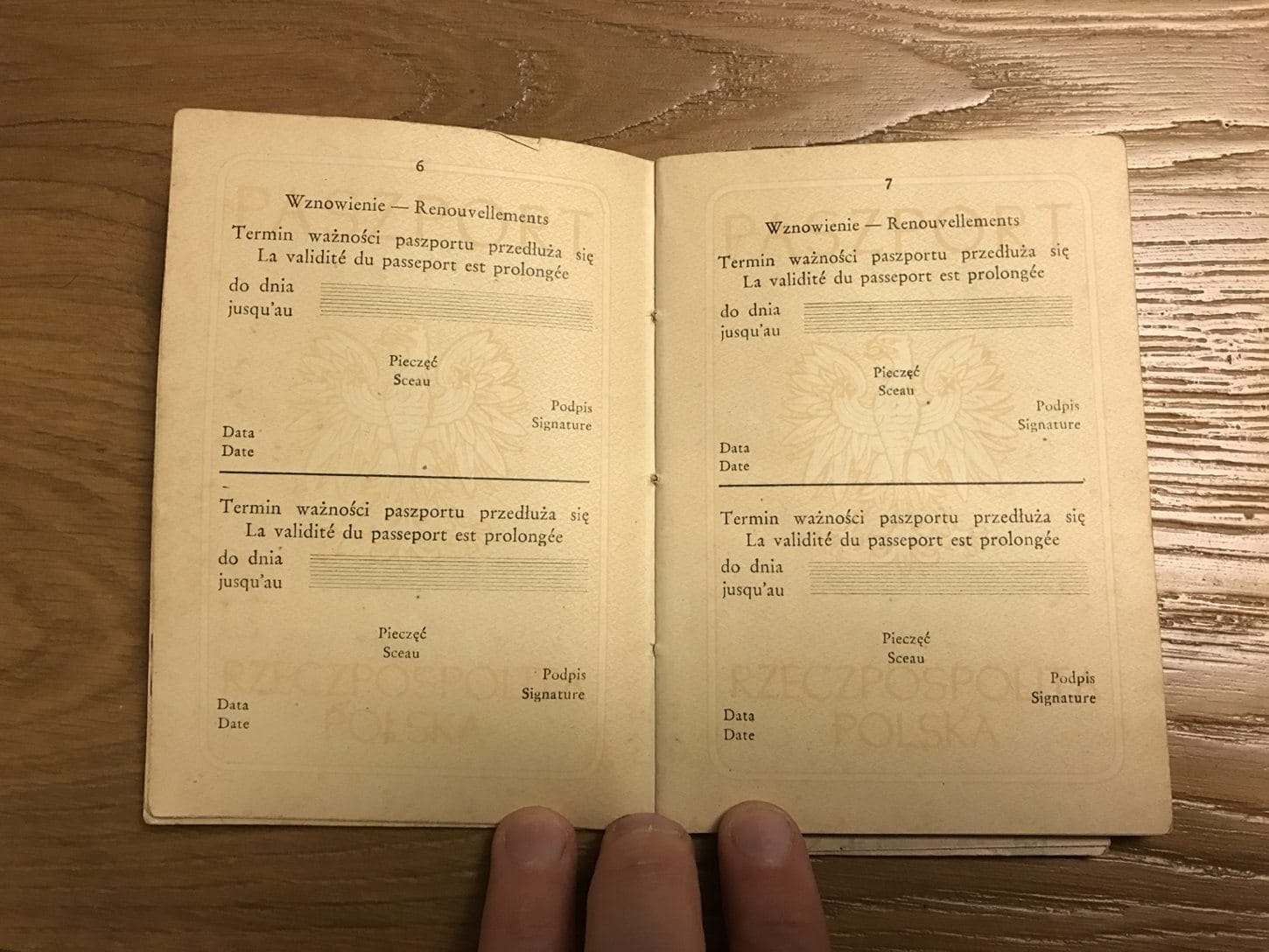
The family holds Majer Gepner's original postwar Polish passport. The photographs below are the family's own; the transcriptions are read directly from the pages.
| Name | Majer Gepner |
|---|---|
| Date of birth | 5 May 1918 |
| Place of birth | Łódź |
| Civil status | kawaler / célibataire — unmarried |
| Profession | ślusarz / serrurier — locksmith, metalworker |
| Residence | Dzierżoniów |
| Description | Tall (wysoki), oval face, black hair, brown eyes |
| Children | None recorded |
| Emigration file no. | 3263/10794 |
| Valid for | Italy — Włochy / Italie |
| Period | Passport and official stamps from 1948 |
Ser. V. 105969 · Nr akt 3263/10794 · stamped „Emigracyjny – d'émigration” · Pobrano: za paszport zł 800, druki 200Series V no. 105969, file 3263/10794, marked as an emigration passport; fees of 800 zł for the passport and 200 zł for forms.Kraje, na które niniejszy paszport jest ważny: Włochy – Italie · Termin ważności paszportu kończy się z dniem 07 grudnia 1948, o ile nie będzie wznowionyValid for Italy; validity ends 7 December 1948 unless renewed. Ministry of Foreign Affairs stamp dated Warsaw, 7 June 1948.Paszport ważny na przekroczenie granicy tam i z powrotem · Warszawa, dnia 07 czerwca 1948 · Dyrektor Biura Konsularnego M.S.Z.Valid for crossing the border there and back; Warsaw, 7 June 1948; signed by the director of the consular bureau of the Ministry of Foreign Affairs.Select any page to view it at full size. Three photographs were taken sideways and are shown rotated; the originals are kept unaltered in the archive.
Gitla Hepner, née Hamer, is the least documented person on the main line and the one the family most wants to find. The Łódź ledger gives her birth, her parents, her marriage and her children, and then stops. After her husband's death in December 1933 no record of her has been found anywhere — and that is not for want of looking. What follows is every place she has been searched for, including a stone-by-stone sweep of the whole Warsaw cemetery, so that whoever picks this up next does not repeat it.

| Name in the records | Gitla Hepner z Hamerów — née Hamer; the Russian-era book would have written Гитля Гамеръ | A2·scan 80·unit 6208176 |
|---|---|---|
| Born | 23 July 1880 in Biała, Rawa county — Biała Rawska Confirmed | A2·scan 80·unit 6208176 |
| Parents | Majer-Chil Hamer and Liba-Ruchla née Goldberg Confirmed | A2·scan 80·unit 6208176 |
| Married | Abram Icek Hepner, on the marriage act of 25 December 1913 — the act itself has not been found; Biała Rawska, the bride's town, is the likeliest registry Confirmed | A2·scan 80·unit 6208176 |
| Legal domicile | Biała, until a certificate of the Biała magistrate of 27 October 1920, no. 1290, transferred her to Łódź (registered 15 November 1920) Confirmed | A2·scan 80·unit 6208176 |
| Children | Chil (died in infancy, family memory); Zysla 1914, Chendla 1916, Majer-Chil 1918, Moszek 1921, Szyja 1923 — all born at Łazy, gmina Falenty Confirmed | A2·scan 80·unit 6208176 |
| Identity-card extract | 29 August 1924, Łódź — the red note „wyc. dow. osob.” on her row; the last dated record of her Confirmed | A2·scan 80·unit 6208176 |
| Widowed | 9 December 1933, Warsaw Confirmed | D1·record 20517 — Avraham Yitzhak Hepner, Okopowa 73/30/30 |
| After 1933 | Family memory: left alone with the children, she „went away”, perhaps to a hospital; Majer later worked for his sister's husband „after both parents were gone”. No record found. Open | F3 |
The ledger names her parents as Majer-Chil Hamer and Liba-Ruchla née Goldberg. Majer-Chil is the name Majer himself was given in 1918 — a child is named for a dead relative, so Gitla's father had died by March 1918; and if the family's memory of a first-born Chil who died in infancy is right, that boy carried the same name first. The Warsaw cemetery database then supplies the mother.
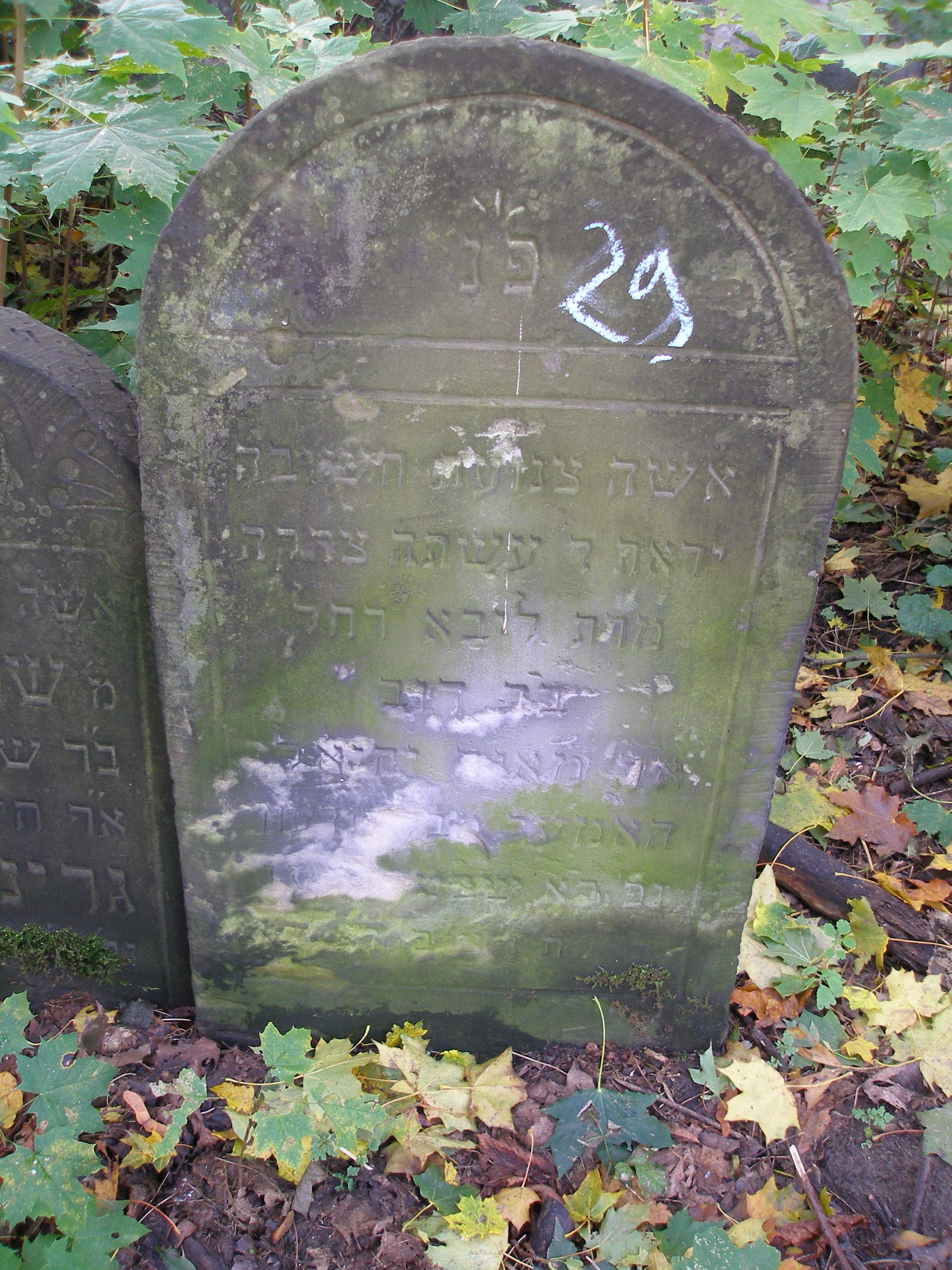
פ״נ
אשה צנועה חשובה
יראה ד׳ עשתה צדקה
מרת ליבא רחל
בת דוב
אשת ר׳ מאיר יחיאל
האמער מב[לענדאוו]
נפ׳ [כ״א שבט תרע״ו]
Here lies a modest and worthy woman, God-fearing, who gave charity: Mrs Liba Rachel, daughter of Dov, wife of R. Meir Yechiel Hamer of Błędów; died 21 Shevat 5676 — 26 January 1916.
Both names match the ledger: Liba-Ruchla is Liba Rachel, and Majer-Chil is Meir Yechiel. The surname is carved האמער, the Yiddish spelling of Hamer. Błędów lies 20 km east of Biała Rawska, in the same corner of Mazovia, so the family had moved once between Gitla's birth in 1880 and 1916, when they were in Warsaw. Her husband is not buried beside her, and now we know why: every one of the sixty-one graves in sector 79, row 3 belongs to a woman. Okopowa buried the sexes in separate rows, so Majer-Chil must be looked for among the men of the same years, not among his wife's neighbours.
| Where | Result | Source |
|---|---|---|
| Warsaw Jewish cemetery, Okopowa — stone database | No Gitla Hepner, Hefner, Heppner or Gepner. Lea Gitel Hefner (died 2 December 1933) is another woman, wife of Natan. The database inventories surviving stones, not burial books, so a lost or unmarked grave would not appear. | D1·record 20517 — Avraham Yitzhak Hepner, Okopowa 73/30/30 |
| Okopowa — every surviving stone, swept for her by three signatures | The whole inventory was read again on 9 September 2026, looking not for her name but for the three ways a widow's stone gives her away: the husband's name, the father's name, and the name Gitel. Two hundred and fourteen women are recorded as the wife of an Avraham Yitzhak, of whom fourteen died in 1934 or later — not one is a Hepner or a Hefner, none has a father called Meir Yechiel, and none is called Gitel. Of the 1,302 women named Gitel or Gitla in the cemetery, only three carry a family surname and all three are already excluded. Three Gitels have a father named Meir Yechiel; they died in 1899, 1911 and 1917. She is not there. | D1·record 20517 — Avraham Yitzhak Hepner, Okopowa 73/30/30 |
| Okopowa, sector 73 — his own sector, all 2,872 stones | The sweep found him exactly where the record says: 73/30/30, Avraham Yitzhak son of Israel David, died 9 December 1933 — which shows the method works. Row 30 is a men's row, sixty-one of its sixty-three stones male, and the neighbouring graves are men who died between 1933 and 1935, so burials ran in order of date within a row. The only other family stones in the whole sector are a Yosef Hefner of 1909 and a Tzvi Goldhamer of 1929. There is no Hepner woman anywhere in sector 73, and the single Gitel in it died in 1925. | D1·record 20517 — Avraham Yitzhak Hepner, Okopowa 73/30/30 |
| Otwock and Pruszków cemeteries — the two hospital towns | Every one of the fifty cemeteries in the database was searched under all eight spellings. Otwock, where the Jewish psychiatric hospital stood, holds one near-match: Malka Gefner, daughter of Ozer Yitzhak, died 6 October 1934 — not her. Pruszków, the town of the Tworki hospital, holds none at all. | D1·record 20517 — Avraham Yitzhak Hepner, Okopowa 73/30/30 |
| Bródno cemetery, Warsaw | No Hepner or Hamer stones. | D1·record 20517 — Avraham Yitzhak Hepner, Okopowa 73/30/30 |
| Łódź Jewish cemetery, Bracka Street — burial database | No Gitla Hepner. Ten Hepner burials, among them a Hendla (quarter K) and a Motel Aron (quarter C), and a Gitla Gepner in quarter G on the right side, whose dates the database does not show online. | D6·search Hepner |
| Yad Vashem — Central Database of Shoah Victims' Names | 207 Hepner victims; the only Gitla is from Radzyń Podlaski, and none of the six Gitla Hamers was born in 1880. Searched again from the other direction, by family rather than by name: nobody in the entire database is recorded as the child of a Gitla née Hamer, and no Hepner has a mother whose maiden name was Hamer. She was never commemorated, and neither were her children under her name. Two names still to check for the daughters: Zosia Hepner, born 1916, Warsaw; Chana Hepner, born 24 October 1918, Bergen-Belsen. | D5·Hepner, all places — 207 victims |
| Geneteka — Jewish civil-record index | No Hamer birth in 1880 (Biała Rawska Jewish records are not indexed), no Hepner–Hamer marriage in 1913, no Hepner death in Warsaw or Łódź 1930–1946. Interwar Warsaw Jewish deaths are not indexed at all. | D4·Hepner, Łódź province |
| Łódź identity-card registers, 1936–1939 | No Gitla Hepner; her sons Majer and Moszek took cards at Gdańska 131 in 1938–39. | A6·scan 205·unit 9645125 |
| Warsaw address and telephone directories | „Hepner Abram, m., Dzika 38”, telephone 413-28, appears in the Warsaw telephone directory for 1930/31 — a second and richer witness for the address than the trade directory, „m.” meaning a private residence. By the 1937 directory there is no Hepner at Dzika 38, and there is no „Hepnerowa”, the form a widow would be listed under, anywhere in Warsaw. No widow carried on that household. | D2·search Genealogy Indexer |
| The Łódź ledger itself, read again | Page 140 was re-read at full resolution for anything written after 1924. There is nothing. The last entry against every one of the seven — Abram Icek, Gitla and the five children — is the same red note, the identity-card extract of 29 August 1924. No death, no strike-through, no transfer out. The book stayed open until 1931 and the clerk simply never wrote in it again. Łódź never recorded what became of her. | A2·scan 80·unit 6208176 |
| Szukaj w Archiwach — name index | „Hamer, Gitla” is attached to two Łódź units: a ledger for houses 1109–1113 with a Hamer household (Abram, Izaak, Pinkus, Estera, Perla) and the property inventory book of Gdańska street, 1929–1949 — the brothers' street. Neither has been read; a Gitla Hamer there could be another woman. | A7·unit 17669833 |
| Arolsen Archives | The online search could not be run from here; still to do. | D7·search Hepner |
Put together, the searches rule out a great deal and leave two possibilities standing.
This is now as certain as the records allow. The community's inventory of about 82,000 stones is the only name index that exists for Okopowa, and she is not in it under her name, under her husband's, under her father's, or in her husband's own sector. She is not at Bródno, not at Otwock, not at Pruszków, not in the Łódź cemetery, and not in any of the other forty-five cemeteries in the database.
She is not among the 200,000 inhabitants of the Łódź ghetto, where her sons had been living, and no one in Yad Vashem is recorded as her child or as a Hepner with a Hamer mother. Had she gone into a ghetto with the family and died there, some trace of her would be expected in one of those lists.
This fits the family's account most simply — Majer worked for his sister's husband once both parents were gone, and he was in Łódź by 1938. A death in Warsaw in those years would be recorded in the Jewish civil registers of the city, which survive only in fragments, and buried at Okopowa, whose stones were destroyed in far greater numbers than they survived. On this reading there is nothing left to find in Warsaw, and the answer would have to come from Łódź, where the family kept its legal domicile.
This is what Majer's memory points at, and it explains the silence better than anything else. A Jewish woman from Warsaw who needed psychiatric care went to Zofiówka in Otwock — the only such hospital in the country for Jews, grown to 275 beds by 1935. Its patients were killed on 19 August 1942, some shot in the wards and the rest sent to Treblinka. People who died that way commonly left no grave, no death act and no name on any list, which is exactly the shape of the gap. It would also explain why the family heard nothing: a patient there was cut off from her children for years before the end.
No patient register for Zofiówka has been found. The collection at the Jewish Historical Institute that looked like the answer turns out to be the postwar TOZ of 1945–49, whose Otwock files are tuberculosis sanatoria, not the psychiatric hospital. Whether any admission book survives — at the Institute, in Otwock, or among the papers of the society that ran the place — has not been established, and that is the next question to put to an archivist rather than to a search box.
Two records would settle her fate, and two archives hold her parents' generation.
Its widow line names her as alive or dead and gives the address. Warsaw Jewish civil records from 1933 are past the 80-year rule and belong in the Archiwum Państwowe w Warszawie; the fonds on Szukaj w Archiwach ends in 1925, so the later books must be asked for by letter.
Akta stanu cywilnego wyznania mojżeszowego w Warszawie, 1858–1925
If she died in Warsaw before the war she is in these; the stone database covers only what still stands. The Jewish Historical Institute holds the community's burial registers.
He is not among the surviving stones, and his wife's row is women only, so the burial books rather than the stones are the way to him: a man who died in Warsaw between January 1916 and March 1918. The Jewish Historical Institute holds the community's registers.
Two fonds survive. In Grodzisk Mazowiecki: marriages 1870–1882 and 1884–1899, deaths 1868–1910, births 1899–1907 — not digitised. In Łódź, online: 1826–1874 and 1885–1886, so a sibling born in 1885–86 would appear with the parents' names. Her own 1880 birth falls in a gap in both.
The stone says the family came from Błędów, Grójec county. Its Jewish records (Geneteka: Błędów mojżeszowe) may hold Majer-Chil and Liba-Ruchla's marriage or a child's birth after 1880.
Tagged „Hamer, Gitla” by the archive's index; 296 scans, 1929–1949. If a Gitla Hamer owned or rented at Gdańska, and the number is 131, the brothers' 1938–39 address becomes her family's — a strong lead, unread.
The same family name appears in four scripts across the records, and each system spelled it its own way. Every form has to be searched separately.
| Language · system | Spelling | Notes |
|---|---|---|
| Hebrew · family usage | העפנער / הפנר | Seen on the gravestone and in family discussion. |
| Yiddish | געפנער | The form the family remembers from the Russian period. |
| Polish · Latin script | Hepner, Heppner, Hefner, Gepner, Giepner, Hegner | Every variant has to be searched independently. Izrael Dawid's own card is written Heppner while the archive index says Hepner; the same register writes one man as „Gepner Hepner” (scan 115) and files the Gepner cards among the Hepners. |
| Russian | Гепнер / Гефнер | Russian renders a foreign H with Г. The Russian-era Łódź ledger writes the family Гепнеръ on the very page whose Polish continuation writes Hepner. |
The alternation between H and G was already normal in Polish records: the Łódź population register of 1916–1921 interfiles Gepner and Hepner cards and, on Icek's address card, writes both spellings for one person. That makes it entirely plausible that an older Hepner line reappears after Soviet documentation as Gepner, although a document tying Majer's own Gepner to a Hepner parent has not yet been found.
Żelechów, a small town in Garwolin county south-east of Warsaw, is currently the strongest geographic hypothesis for Avraham Yitzhak's birth. The reasons are cumulative rather than conclusive.
Żelechów Yizkor material: JewishGen Żelechów Yizkor Book
Two questions the family asks — where they lived in Warsaw, and where Zysla lived in Łódź — are still open. This is every address the records give so far.
| Place | Address | Who | When | Status | Note | Source |
|---|---|---|---|---|---|---|
| Łódź | House 754 (police number), circuit III | Srul Dawid's household; later Abram Icek, Gitla and the children | 1891–1923 | Confirmed | The registration address in every ledger. The street behind the police number has not yet been established. | A2·scan 78·unit 6208176 |
| Łódź | Skwerowa 16, later Benedykta 42 | Izrael Dawid | 1916–1920 | Confirmed | From his census card; he left for Warsaw in June 1920. | A1·scan 118·unit 6209045 |
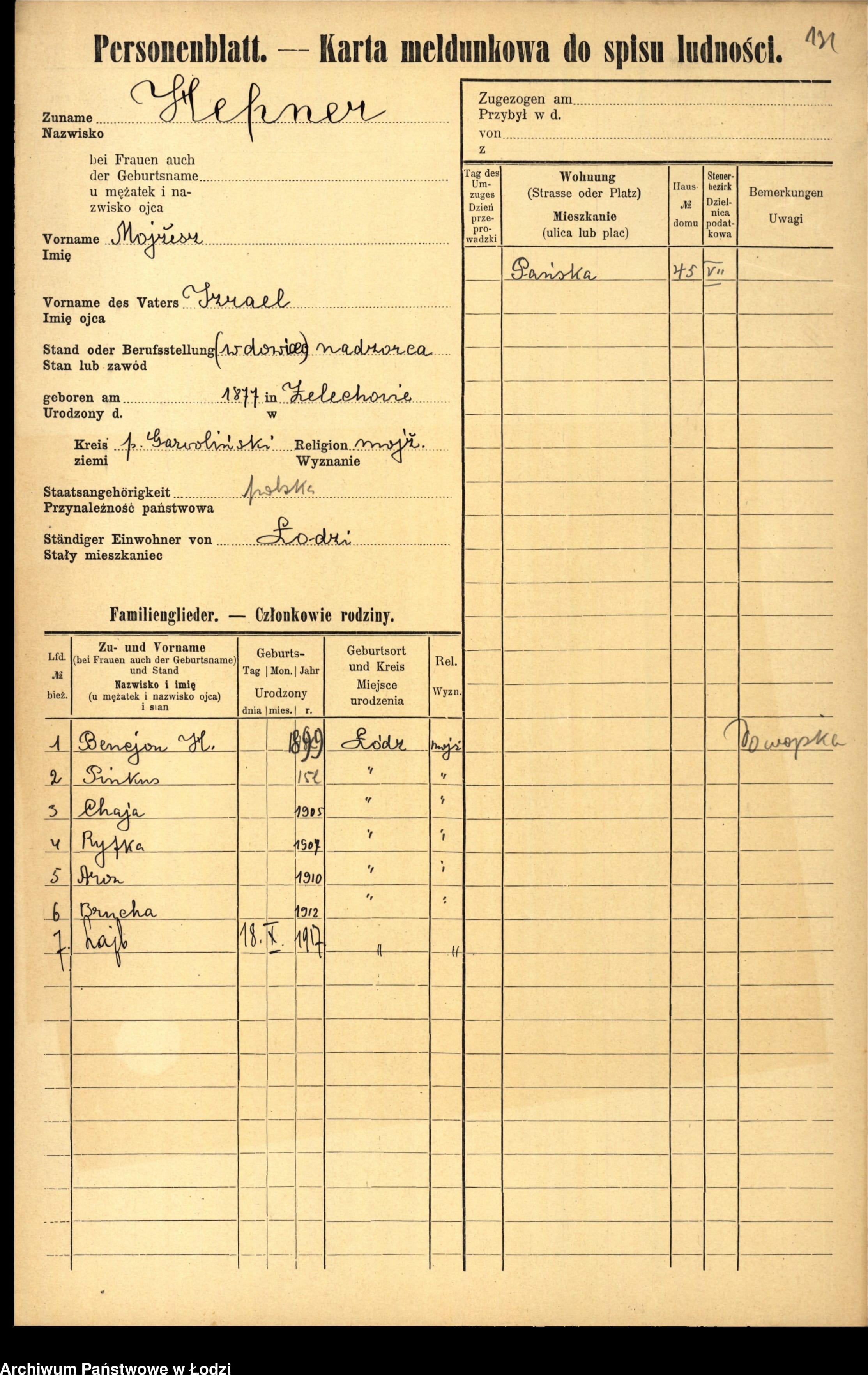
| Łódź | Pańska 45 | Mojżesz Hepner and his seven children | 1916–1921 | Confirmed | Avraham Yitzhak's elder brother. | A1·scan 133·unit 6209045 |
| Łazy, gmina Falenty | The farm — no house number recorded | Abram Icek, Gitla and the five children | 1914–1923 | Confirmed | Five births there; the ledger names only the village. | A2·scan 80·unit 6208176 |
| Warsaw | Dzika 38 | „Hepner Abr., handl.” | 1930 | Unverified | The only Warsaw address we have. The directory entry fits Avraham Yitzhak, but no record ties it to him; the 1933 death act would settle it. | D2·search Genealogy Indexer |
| Łódź | Gdańska 131 | Moszek (1938) and Majer-Chil (1939) | 1938–1939 | Confirmed | Both brothers' identity cards. Family memory has Majer working for his elder sister's husband after the parents' deaths, so this may be that sister's household — a hypothesis until her married name is found. | A6·scan 205·unit 9645125 |
| Łódź | Unknown | Zysla | 1930s | Open | Not in the 1936–1939 identity-card registers under Hepner; at twenty-two to twenty-five she was probably registered under a married name. | A6·unit 9645125 |
| Łódź | Zawadzka 22 | Motek-Aron Hepner, born 1870 in Żelechów | 1936 | Kin unproven | A Hepner of Izrael Dawid's generation from the same town. | A5·scan 6·unit 9645124 |
| Lublin | Not recorded | Symcha Binem, Ryfka and their children | 1922–1929 | Confirmed | Registered back in Łódź at house 754 in 1924. | A2·scan 79·unit 6208176 |
| Dzierżoniów | Not recorded | Majer Gepner | 1948 | Confirmed | Residence on the emigration passport. | F2 |
What the family remembers, written down as told. None of it is treated as fact until a record confirms it — but each memory points at a document, and one of them has already been matched by the gravestone.
Majer was born in a village called Łazy, not far from Warsaw, where Avraham Yitzhak had a farm or was a partner in one. The family visited the village on its trip to Poland.
Confirmed by the Łódź ledgerAmir Gafner, from family stories
Page 140 of the Łódź ledger gives every child's birthplace as wieś Łazy, gmina Falenty, powiat warszawski — Zysla 1914, Chendla 1916, Majer 14 March 1918, Moszek 1921, Szyja 1923. That Łazy lies about 15 km south-west of Warsaw, in today's gmina Lesznowola. The passport's „Łódź” was the family's registration town, not the birthplace.
The birth act itself, in the Jewish registry that served gmina Falenty, would fix the day (14 March against the passport's 5 May). Land or lease records for Łazy would show the farm.
Avraham Yitzhak grew and traded vegetables.
OpenAmir Gafner, from family stories
A 1930 Warsaw address directory lists „Hepner Abr., handl., Dzika 38” — a trader (handlarz) of that name. Whether this is our Avraham Yitzhak is not yet proven.
The 1933 Warsaw death act (occupation and address); Warsaw trade registers; the directory entry's telephone subscriber file.
He moved the family to Warsaw so that Majer, his eldest son, could study in a cheder with a bigger rabbi.
OpenAmir Gafner, from family stories
Dzika 38 — the address in the 1930 directory — housed three cheders with about 133 boys in the 1930/31 school year, according to the research notes. The move would fall between Majer's birth in 1918 and 1930. Izrael Dawid, the probable grandfather, had gone to Warsaw in June 1920.
Warsaw registration or kehilla school records for Dzika 38; the death act's address line.
Avraham Yitzhak died when Majer was about fourteen.
Matches the gravestoneAmir Gafner, from family stories
The stone and the cemetery record give 9 December 1933; Majer, born 14 March 1918, was fifteen and three-quarters. Memory and record agree within two years.
Already settled by the gravestone.
Majer's mother is a mystery. Her name may have been Gitla. After her husband's death she was left alone with many children and „left” — perhaps she was hospitalised.
Her name is confirmedAmir Gafner, from family stories
Page 140 of the Łódź ledger: Gitla Hepner née Hamer, born 23 July 1880 in Biała, Rawa county, daughter of Majer-Chil Hamer and Liba-Ruchla Goldberg, registered on the marriage act of 25 December 1913. Her mother is probably the Liba Rachel Hamer buried at Okopowa in January 1916; her father, after whom Majer was named, had died by 1918. What became of her after 1933 is still unknown — section 05 lists every place she was looked for.
The widow line of the 1933 death act; Warsaw and Łódź death records and hospital admission books after 1933; the 1913 marriage act.
Majer had an older sister, Henia, who survived Auschwitz, reached Sweden and then Israel, where she reunited with her brothers: Majer, Moshe — who went to Israel and later to Brazil — and the youngest, Shea (Yehoshua), who lived in Haifa.
Confirmed by the Łódź ledgerAmir Gafner, from family stories
Page 140: Chendla born 10 September 1916 — Henia, named after her grandmother Hendla who had died on 8 August 1914 — Moszek born 16 April 1921 and Szyja born 9 March 1923, all at Łazy. Four names remembered, four rows in the book.
Henia's Auschwitz, Swedish and Israeli records; Moshe's Brazilian and Yehoshua's Israeli records, to carry the line forward.
Henia was older than Majer but not the eldest: another sister — her name may have been Chana — was already married and living in Łódź with a family of her own. After the parents died, her husband took Majer to work for him installing radios: climbing onto rooftops to fit the aerials for the sets in the flats below.
Probable — she is ZyslaAmir Gafner, from Majer's own stories
Page 140 names the eldest child: Zysla, born 8 July 1914 at Łazy — four years older than Majer, the sister the story places in Łódź with a family of her own; the remembered name „Chana” belongs to an aunt, Chana Fajga, born 1902. „After the parents died” implies Gitla also died, in or after 1933. The Łódź identity-card registers of the 1930s are tagged with Majer Chil, Moszek, Symcha and Chendla Hepner — the family back in Łódź, as the story says.
Zysla's marriage record in Łódź (1930s); the ID-card register entries (units 9645124 and 9645125), which give birth date, address and occupation; Gitla's death record.
Before Majer there was a first-born son, Chil — Yechiel — who died very young, perhaps within his first year.
Open — consistent with the ledgerAmir Gafner, from family stories
The Łódź ledger's 1923 entry lists only living children, so an infant who died before 1923 would not appear; Zysla (1914) is the first child written. The name fits: Gitla's father was Moszek-Chil Hamer, and Majer was registered as Majer-Chil — the lost brother's name carried forward, as custom required.
Jewish birth and death registers for gmina Falenty, about 1912–1918; the grave would have been in the district's Jewish cemetery.
Henia introduced her best friend from Auschwitz, Rachel Guttman of Warsaw, to her brother Majer. They married; Rachel is the writer's grandmother.
Family knowledgeAmir Gafner, direct family knowledge
Majer's 1948 passport still shows him unmarried, so the marriage came after the emigration passport was issued.
Not a research question; noted so the Guttman line can be added later.
The family were Hasidim. A paternal relative remembers that an ancestor — roughly „grandfather's grandfather” — was connected to Kotzk.
Open — geography fitsEli Gafner (Majer's son); the exact rebbe the family followed is not remembered
Kock (Kotzk) lies 42 km from Żelechów, inside the same Przysucha family of courts as the town's own mid-century rebbe. See the next section.
Obituary notices in the Warsaw Yiddish press, 10–13 December 1933, which often name the shtibl; the Żelechów yizkor book's chapter on the town's Hasidic circles; Okopowa burial-society records.
Majer was in the USSR during the war, and there the surname was written and pronounced Gepner.
PlausibleFamily memory; the 1948 passport already reads Gepner
Russian regularly renders a foreign H as Г, and the Łódź register shows Gepner and Hepner used for the same people before the war.
Soviet wartime records under Гепнер / Гефнер, Майер / Меер; postwar Dzierżoniów and Central Committee of Polish Jews registers.
The family knows it was Hasidic and remembers Kotzk, but not the rebbe it followed. The town itself gives the strongest hints: Żelechów sat inside one particular family of Hasidic courts, and every one of them was a day's journey away.
Żelechów was a Hasidic town from the movement's first generation. Levi Yitzchak of Berditchev (1740–1809), a disciple of the Maggid of Mezritch, served as its rabbi in the early 1770s after Ryczywół and before Pinsk and Berdichev, and met fierce opposition there from the Mitnagdim — the town was contested ground before it was Hasidic ground.
In the middle of the nineteenth century Żelechów had a rebbe of its own: Yehoshua Asher Rabinowicz (1798–1862), son of the Holy Jew of Przysucha, held court in the town before moving it to Parysów, 24 km away. The Przysucha school is the one from which Kotzk grew — Menachem Mendel Morgenstern was the Holy Jew's and Simcha Bunim's disciple — so a Żelechów family of the 1840s and 1850s lived inside the same family of courts whether it prayed with the town's rebbe or travelled to Kock.
Kock is 42 km to the south-east. The Kotzker settled there in 1829 and died in 1859; most of his followers then went to Yitzchak Meir Alter, the Chiddushei HaRim, whose court at Góra Kalwaria (Ger), 51 km to the west, became the largest in Poland. A smaller Kotzk line continued under the Kotzker's son David in Kock and later at Puławy (Pilov) and Sokołów, and his son-in-law Avraham Bornsztain founded Sochaczew. A family that remembers „Kotzk” could, by the 1920s, have belonged to any of these — or to a Kotzk-minded shtibl in Warsaw.
The Żelechów yizkor book (1953) has a chapter, in Yiddish, on the town's Hasidic circles, and another on „the rebbe's yard”. It is the natural place to learn which shtiblekh existed in the town in the years Izrael Dawid and his children lived there, and it has not yet been read for this research.
Kock, Puławy or Sokołów. Geography favours it for the Żelechów generation; a Warsaw shtibl of the Sokołów rebbe existed in the interwar years.
The most common outcome for Kotzker families after 1859. In Warsaw of the 1920s and 1930s Ger had by far the most shtiblekh.
The town's own rebbe's line, later in Parysów and Warsaw; a family may have kept the affiliation after moving.
The memory may attach to where the family prayed in Warsaw rather than to a court it travelled to.
„Rabbi”, „rebbe” and „shtibl” are not the same thing. A rabbi was a halakhic authority with a communal appointment; a rebbe was a Hasidic leader accepted by followers, usually by descent by the late nineteenth century; a shtibl was a prayer room of one court's followers. Interwar Warsaw had hundreds of shtiblekh, and many small courts had only a few. The family's memory could attach to any of the three levels.
What the Łódź ledgers did not answer. These questions stay open here until a record closes them; the sources most likely to do so follow, in priority order, each checked against what the archives actually hold. Three of the first four sit in one place, the Grodzisk Mazowiecki branch of the Warsaw state archive, so a single letter would start most of this.
Akta gminy Falenty, 73/1358/0 · 1909–1954 · 28 files, 15 inventoried, 2 linear metres · Archiwum Państwowe w Warszawie, Oddział w Grodzisku Mazowieckim · not digitised, no file list online
The gmina's own papers survive, and the description names „księgi ludności stałej i rejestry mieszkańców” — permanent population books and resident registers. The family lived in this gmina, at Łazy, from 1914 to 1923. This is the local twin of the Łódź ledger that gave us nearly everything we know, and nobody has opened it. Twenty-eight files is an afternoon's work, but the inventory exists only on paper at the branch, so it starts with a letter. That same branch holds the Nadarzyn and Biała Rawska registers below, so one letter covers three of these targets.
Nadarzyn, 73/180/0 — births to 1916 · Grodzisk Mazowiecki, 73/280/0 — to 1922 · Piaseczno, 73/1398/0 — births stop in 1911 · Warsaw, 72/200/0 — online but fragmentary after 1915
Zysla 1914, Chendla 1916, Majer 1918, Moszek 1921 and Szyja 1923 were all born in the village, and Raszyn and Falenty had no synagogue district of their own. Checking each neighbour's surviving years narrows it sharply: Nadarzyn's births run to 1916 and so could hold Zysla and Chendla; Piaseczno's stop in 1911 and resume only in 1940, so it cannot hold any of them; Grodzisk reaches 1922. For Majer, Moszek and Szyja the books may never have reached an archive at all — under the hundred-year rule they would still sit with the civil registry office covering Łazy, today in gmina Lesznowola. Majer's act would settle his birthday, 14 March by the ledger against 5 May on the passport.
Should give the address, occupation, the widow's name and the informants — and settle where the family lived in Warsaw, whether Dzika 38 is right, and what Gitla did next. Records of that date are past the hundred-year rule and belong in the state archive rather than the registry office.
Jewish civil registry of Biała Rawska, or of Łódź · JRI-Poland
The act would give the witnesses, the rabbi and the couple's addresses — the last a clue to the Łazy farm — and name Gitla's parents in full. It is not in the Łódź index, and 1913 falls in a gap in both Biała Rawska fonds, so a retained registry-office copy may be the only one.
The family remembers that she „left”, perhaps to a hospital, and Majer's story of working for his sister's husband implies both parents had died. Warsaw and Łódź Jewish death registers 1933–1939, hospital admission books, and the Warsaw community's burial registers at the Jewish Historical Institute are the sources.
Przełożony Starszeństwa Żydów w Getcie Łódzkim, fonds 28211, Archiwum Państwowe w Łodzi, 1939–1944 · the Lodz-Names register of about 200,000 ghetto inhabitants
The ghetto administration's own archive survives almost complete, and its register of inhabitants gives each person's birth date, occupation and address inside the ghetto. Majer and Moszek were at Gdańska 131 in 1938 and 1939. Whoever of the family was still in the city in 1940 was moved into the ghetto and is in that register; so, probably, are the aunts and the cousins from Pańska 45. This is the largest untouched body of records bearing on the family.
Centralny Komitet Żydów Polskich, Wydział Ewidencji i Statystyki, 303/V, Żydowski Instytut Historyczny
Survivors registered with the Jewish committees after the war, giving their birth date, birthplace, wartime path and surviving relatives. The provincial committee for Lower Silesia sat at Dzierżoniów — the town on Majer's 1948 passport. This is the likeliest place to find him described in his own words, and possibly Henia and Moshe beside him.
Arolsen Archives · Auschwitz Museum prisoner database · Riksarkivet, Statens utlänningskommission · FamilySearch, Brazil immigration cards · Israeli immigration records · JDC archive
Henia went from Auschwitz to Sweden in 1945, and the Swedish alien commission files hold a long personal interview with each arrival. Moshe went to Brazil, whose immigration cards are indexed. Majer passed through Italy in 1948, which the Joint Distribution Committee documented. Szyja reached Haifa. Arolsen covers all four and has still not been searched properly.
If Avraham Yitzhak bought or leased land at Łazy, a notary drew up the deed, with the sum, the terms, the other party and the witnesses; and any property carried a mortgage book. The notarial records for the district and the land books for powiat warszawski would show whether he owned the farm, rented it, or worked someone else's. For a rural household these are often the richest surviving papers, and none has been looked at.
Łódź Jewish marriages 1932–1939 (Geneteka, JRI-Poland) · Szukaj w Archiwach unit 9645117
The 1936–1939 registers have been read: Majer and Moszek are there, Zysla and Chendla are not. Zysla's marriage act would give her married name and address — probably the Gdańska 131 household. The 1934–1935 volume, tagged with a Srul Szyja Hepner, is still unread.
Haynt · Der Moment · Dos Yidishe Togblat · Nasz Przegląd — Polona and the CBJ digital libraries
Death notices often name the deceased's shtibl or rebbe, his children and his address — the most direct route to the Hasidic affiliation the family no longer remembers, and a second witness for the Warsaw address.
Community membership rolls, the tax each household paid, burial payments and charity lists. These name people the vital records miss, and a payment to a particular prayer house is the kind of entry that would finally answer the question of which Hasidic court the family belonged to.
Świadectwa przemysłowe · Izba Skarbowa · Warsaw and Łódź address and trade directories, 1926–1939, indexed by Genealogy Indexer
A trader needed a licence and paid a patent tax, and both left files. Read together with the directories these would test the „Hepner Abr., handl.” of 1930, say what he actually dealt in, and give the years on either side of it.
JRI-Poland / JOWBR — Bracka Street, Łódź (login) · Warsaw Jewish community burial books
Hendla died in Łódź on 8 August 1914 and a Hendla Hepner stands in quarter K of the Łódź cemetery. Izrael Dawid was alive in 1927; the Warsaw, Bródno, Żelechów and Łódź stone databases have all been searched without him, so the burial registers are next. Any stone of his carries the priestly hands.
JRI-Poland · Żelechów births and marriages
Srul Dawid's birth (1854, parents Abram and Sura), Hendla Gottheld's (1858, parents Moszek and Liba), their marriage (about 1876–1880), Moszek Berek's birth (1878) and Sura Sima's (1881) would carry the line back another generation and name the Gottheld family.
JRI-Poland · Żelechów births 1870 and 1896 · Łódź death registers
Motek-Aron Hepner, born 19 July 1870 in Żelechów, took an identity card in Łódź in 1936 and is probably the Motel Aron in quarter C of the Łódź cemetery; Fela Hepner, daughter of Aron, born there in 1896, reached Łódź in 1921. If Motek-Aron is Fela's father, his own birth act would say whether he and Izrael Dawid were brothers.
AP Warszawa Oddział w Grodzisku Mazowieckim, 73/1122/0 (1853–1923, not digitised) · AP Łódź 39/1407/0 (1826–1874, 1885–1886, online) · Geneteka, Błędów mojżeszowe
Gitla's parents Majer-Chil Hamer and Liba-Ruchla Goldberg — their marriage (Biała marriages 1870–1882, 1884–1899), her siblings (births 1885–1886 online; 1899–1907 in Grodzisk) and his death (Biała deaths to 1910, or Warsaw 1916–1918). The maternal line of Majer's generation, and the same branch as targets 1 and 2.
„Di khsidishe krayzn in Zshelekhov”, I. Wajnberg, p. 141 (Yiddish)
Which shtiblekh existed in Żelechów in the 1850s–1880s, when Srul Dawid and Hendla grew up there, and which Hasidic houses of prayer stood near Dzika 38 in the 1930s. Błędów, the town Gitla's mother came from, was itself a Hasidic court seat, which ties the two ends of the family together.
Every person named in this archive: who they are, how they connect, what we hold on them and where to look next. Links open the archival unit, the record, or a search already filled in where the database allows it. Open a name to see its leads.
Open the family treeFive generations on one page, each name linked to its card.
Srul Dawid's parents, known only by name from the earlier Łódź ledger — Majer's great-great-grandparents. Nothing else has been found on them.
Izrael Dawid, a weaver, born 1854 in Żelechów; married Hendla Gottheld; in Łódź by 1885 and registered there in 1891 at house 754. Father of Mojżesz, Sura Sima, Abram Icek, Gitla, Estera, Chawa, Symcha Binem and Chana Fajga. Left for Warsaw in 1920 and was alive in 1927. Majer's paternal grandfather.
Srul Dawid's wife, born 1858 in Żelechów to Moszek and Liba Gottheld; mother of the eight children on ledger page 138; died in Łódź on 8 August 1914. A Hendla Hepner in quarter K of the Łódź cemetery is probably her. Chendla — Henia, born 1916, carries her name.
Eldest son of Srul Dawid and Hendla, born 1878 in Żelechów; left Łódź in 1896; back by 1916 as a widowed overseer at Pańska 45 with seven children. He died in the Łódź ghetto on 23 May 1941, at Reiger Gasse — ulica Spacerowa — 6, flat 16, with his son Lajb in the same flat. Avraham Yitzhak's elder brother — Majer's uncle.
Eldest daughter, born 1881 in Żelechów, the last child born there; married about 1903 (the husband's name reads like Goldman) and was struck off the Łódź ledger. Majer's aunt.
Avraham Yitzhak — Majer's father. Born 30 August 1885 in Łódź, fourth child of Srul Dawid and Hendla; a Kohen. Married Gitla Hamer on 25 December 1913, farmed at Łazy near Warsaw where their children were born, died in Warsaw on 9 December 1933 and lies at Okopowa.
Avraham Yitzhak's younger sister, born 1888; married Jankiel Friedman of Biała Podlaska in Łódź in January 1917. Majer's aunt — not to be confused with his mother, Gitla née Hamer.
Sister of Avraham Yitzhak, born 1890; married Abram Aksel[berg] and was registered with him in Łódź in 1918. Majer's aunt.
Sister of Avraham Yitzhak, born 1894 (the census card says 1895) — the Chawa / Ewa the family remembers; unmarried and with her father in 1921. Majer's aunt.
Brother of Avraham Yitzhak, born 1896 — the Binem / Beno the family remembers. Married Ryfka Frydman in Lublin in 1922; four children born there; back in Łódź at house 754 by 1924. Majer's uncle.
Youngest sister of Avraham Yitzhak, born 1902 (the card says 1900) — the Fajga the family remembers. Married Abram Icek Buk of Skierniewice in 1925; the family moved from Łódź to Białystok, and she was murdered in the Shoah. Her Page of Testimony repeats the ledger exactly — father Srul David, mother Hendla née Gothelf — and was filed by a great-granddaughter, so a branch of the family survived. Majer's aunt.
Majer's mother. Born 23 July 1880 in Biała, Rawa county, to Majer-Chil Hamer and Liba-Ruchla née Goldberg; married Abram Icek on 25 December 1913; bore Zysla, Chendla, Majer, Moszek and Szyja at Łazy; widowed in 1933, after which no record has been found. Section 05 gathers everything known about her.
Gitla's parents, named on her ledger row — Majer's maternal grandparents. Majer-Chil is the name Majer was given in March 1918, so he had died by then. Liba-Ruchla is probably the Liba Rachel Hamer, daughter of Dov and wife of Meir Yechiel, from Błędów, who died in Warsaw on 26 January 1916 and lies at Okopowa, sector 79, row 3, grave 29.
The first child of Abram Icek and Gitla, remembered by the family as Chil — Yechiel, who died in his first year; he is in no register. If the memory is right he was named for Gitla's father Majer-Chil Hamer, as Majer was after him.
Eldest daughter of Abram Icek and Gitla, born 1914 at Łazy — the elder sister the family remembers as married and living in Łódź, whose husband employed Majer after both parents were gone. Her married name is not known.
Henia — second daughter of Abram Icek and Gitla, born 1916 at Łazy and named after her grandmother Hendla. Survived Auschwitz, reached Sweden, then Israel; she introduced her friend Rachel Guttman to Majer.
Majer Gepner, born 14 March 1918 at Łazy, third child and eldest surviving son of Abram Icek and Gitla, named after his maternal grandfather Majer-Chil Hamer. In Łódź at Gdańska 131 in 1939; married Rachel Guttman; Dzierżoniów and emigration in 1948; Israel. Father of Avraham (Rami) and Eliyakim (Eli); Amir's grandfather.
Moshe — fourth child of Abram Icek and Gitla, born 1921 at Łazy; took a Łódź identity card in 1938 at Gdańska 131, where his brother Majer followed a year later. Israel, then Brazil.
Shea — Yehoshua, the youngest child of Abram Icek and Gitla, born 1923 at Łazy. Haifa.
Majer's wife, from Warsaw; Henia's friend from Auschwitz, who introduced them after the war. Amir's grandmother.
A Hefner couple at Okopowa: Lea Gitel, daughter of Eliezer and wife of Natan, died on 2 December 1933, a week before Avraham Yitzhak. She is not Gitla née Hamer; whether the couple are kin is open.
A Żelechów-born Hepner of Izrael Dawid's generation who took a Łódź identity card in January 1936 at Zawadzka 22, and is probably the Motel Aron Hepner buried in the Łódź cemetery, quarter C. Possibly the Aron who fathered Fela; no record yet joins him to Izrael Dawid — a brother or a cousin would be the natural guess.
Born 1896 in Żelechów to Aron and Estera Bina; reached Łódź in 1921. If Motek-Aron Hepner, born 1870 in Żelechów, is her father, the Żelechów Hepners had two branches in Łódź.
Born 1893 in Żelechów, son of an Israel, in Soviet repression records. He cannot be Izrael Dawid's son — the family was in Łódź by then — but may be kin.
Scroll sideways to see every branch. Click a name to open its card.
Every claim on this page, with the reason for its status and the records it rests on. The source codes link to section 13, where each record has its archive reference and scan links.
| Claim | Status | Reason | Sources |
|---|---|---|---|
| Avraham Yitzhak was the son of Israel David | Confirmed | Gravestone and cemetery record; Łódź ledger page 138, row 4, names Abram Icek as the son of Srul Dawid and Hendla Gottheld. | F1D1A2 |
| Avraham Yitzhak was born on 30 August 1885 in Łódź | Confirmed | Łódź ledger page 138 (18/30 August 1885, Łódź) and page 140 (30 August 1885, Łódź); the earlier ledger, page 144, agrees. | A2A3 |
| Avraham Yitzhak died 9 December 1933 in Warsaw, aged 48, and is buried at Okopowa | Confirmed | Cemetery database and gravestone; the ledger birth date makes the weathered age מ״ח, 48 — the 45 reading is excluded. | D1F1A2 |
| Avraham Yitzhak was born in Żelechów | Disproven | The ledger gives Łódź. Żelechów is where his parents, and his elder siblings Moszek Berek (1878) and Sura Sima (1881), were born. | A2A3 |
| Izrael Dawid Hepner, born 1854 in Żelechów, son of Abram and Sura, a weaver, lived in Łódź from at least 1885 | Confirmed | Łódź ledger page 138; his 1916–1921 census card gives 1855 and Skwerowa 16. | A2A1 |
| Izrael Dawid's wife was Hendla née Gottheld, born 17 May 1858 in Żelechów, died in Łódź 8 August 1914 | Confirmed | Łódź ledger page 138, row 2, with the death note in Polish. | A2 |
| Izrael Dawid left Łódź for Warsaw in June 1920 | Probable | Pencil note „do Warszawy” with a June 1920 date on his 1916–1921 card; a stamp on the ledger records an identity-card extract for him in 1927, so he was alive then — where is not stated. | A1A2 |
| Mojżesz Hepner, born 1877 in Żelechów, son of Izrael, is Avraham Yitzhak's elder brother | Confirmed | The earlier ledger, page 143, row 9, lists Moszek Berek, born 18 June 1878 in Żelechów, son of Srul Dawid and Hendla Gottheld; the 1916–1921 card (scan 133) gives 1877 and father Izrael — the same man, a year out. | A3A1 |
| Avraham Yitzhak married Gitla née Hamer, born 23 July 1880 in Biała, Rawa county, on 25 December 1913 | Confirmed | Łódź ledger page 140, row 2: daughter of Majer-Chil Hamer and Liba-Ruchla Goldberg; registered on the marriage act of 25 XII 1913 and transferred from Biała on a magistrate's certificate of 27 X 1920. | A2 |
| Gitla's mother is the Liba Rachel Hamer, wife of Meir Yechiel, from Błędów, buried at Okopowa on 26 January 1916 | Probable | Both names match the ledger (Liba-Ruchla; Majer-Chil = Meir Yechiel) and Błędów is 20 km from Biała Rawska. The stone has not been read in full and Majer-Chil's own grave has not been found. | D1A2 |
| Majer was named after his maternal grandfather Majer-Chil Hamer, who had died by March 1918 | Hypothesis | Ashkenazi naming after the dead; the ledger gives the grandfather's name and Majer's full name Majer-Chil. The family's first-born Chil, who died in infancy, would have carried the name first. | A2F3 |
| Majer was born on 14 March 1918 in the village of Łazy, gmina Falenty, near Warsaw | Confirmed | Łódź ledger page 140, row 5, and his 1939 identity card (card 1353), which repeats 14 March 1918, Łazy, gmina Falenty. The 1948 passport gives 5 May 1918 and Łódź; Łódź is the registration town. | A2A6F2 |
| Majer's siblings were Zysla (1914), Chendla — Henia (1916), Moszek — Moshe (1921) and Szyja — Yehoshua (1923), all born at Łazy | Confirmed | Łódź ledger page 140, rows 3–7; Moszek's 1938 identity card repeats 16 April 1921, Łazy. Matches the family's Henia, Moshe and Shea and the remembered elder sister. | A2A6F3 |
| Majer and Moszek lived at Gdańska 131, Łódź, in 1938–1939 | Confirmed | Identity cards 1388 (8 July 1938) and 1353 (30 May 1939), both issued to that address. | A6 |
| Symcha Binem and Chawa were on the books at house 754 before the 1903 ledger was opened | Confirmed | The 1897–1902 book, page 568, lists both with their parents' names and stamps them over to page 138 of the new book. | A4A2 |
| Avraham Yitzhak never served in the Russian army: at the 1906 call-up he was released altogether from military service | Confirmed | Ledger page 138, row 4: „въ 1906 уволенъ вовсе отъ военн. службы”, the statutory formula for a man found wholly unfit (Устав о воинской повинности 1874, art. 32). Born 30 August 1885, he belonged to the 1906 levy (art. 11); his passport ran to 15 October 1906 and the next was issued 30 January 1907. A family exemption would instead have enrolled him in the militia (arts. 45, 154). | A2 |
| Avraham Yitzhak farmed at Łazy and traded vegetables | Probable — the place is proven | The family lived at Łazy for at least 1914–1923 (five births). The ledger leaves his occupation blank; a „Hepner Abr., handl.” (trader) at Dzika 38 in the 1930 Warsaw directory is consistent but not yet shown to be him. | A2D2F3 |
| The family's Warsaw address was Dzika 38 | Hypothesis | Only the 1930 directory entry „Hepner Abr., handl., Dzika 38”. No record ties it to Avraham Yitzhak; the 1933 death act would settle it. | D2 |
| The family moved to Warsaw so that Majer could study in a cheder with a bigger rabbi | Open | Family memory. The family re-registered in Łódź in December 1923 and took an identity-card extract there in August 1924; a Hepner Abr. is at Dzika 38, an address with three cheders, in 1930. The move falls between 1924 and 1930. | F3A2D2 |
| Avraham Yitzhak died when Majer was about fourteen (family memory) | Matches the record | 9 December 1933; Majer was fifteen and three-quarters. | F3D1 |
| Gitla was left with the children after 1933 and „left”, perhaps to a hospital | Open | Family memory; no record of her after the identity-card extract of 29 August 1924. Not at Okopowa, Bródno or the Łódź cemetery under Hepner, Hefner or Gepner; not in Yad Vashem's names database; not in Geneteka. Section 05 lists the searches. | F3D1D6D5D4 |
| Majer-Chil Hamer has no surviving gravestone at Okopowa | Confirmed | The whole Okopowa list was read sector by sector on 8 September 2026: of eighty-nine men named Meir Yechiel or Yechiel Meir, none is a Hamer. Sector 79, row 3, where his wife lies, holds sixty-one women and no men. | D1 |
| Chana Fajga, Avraham Yitzhak's youngest sister, was murdered in the Shoah after the family moved from Łódź to Białystok | Confirmed | A Page of Testimony at Yad Vashem, indexed under the mis-transcribed surname „Harner”, gives her born 14 September 1902 in Łódź to Srul David and Hendla née Gothelf, married to Buki Abram Isek — every detail matching ledger page 138, row 9, and the 1925 note of her marriage to Abram Icek Buk of Skierniewice. Filed by a great-granddaughter. | D5A2 |
| Mojżesz Hepner, Avraham Yitzhak's elder brother, died in the Łódź ghetto on 23 May 1941 | Probable | The ghetto register of inhabitants has Moszek Hepner, born 1877 — the year his 1916–1921 card gives — at Reiger Gasse (Spacerowa) 6, flat 16, died 23 May 1941. His son Lajb, born 1917, is in the same flat, and Bencion (1899) and Pinkus (1902) are on the same list, matching the children on his card. The identification rests on the cluster rather than on any one name. | D5A1 |
| Gitla has no surviving gravestone anywhere in the database | Confirmed | The Okopowa inventory of about 82,000 stones — the only name index that exists for that cemetery — was swept on 9 September 2026 for her name, her husband's, her father's, and for the name Gitel. Of 214 women recorded as the wife of an Avraham Yitzhak, the fourteen who died in 1934 or later are none of them Hepner, Hefner or Gitel. All fifty cemeteries in the database were searched under eight spellings, Otwock and Pruszków among them. | D1 |
| Hendla née Gottheld is buried in the Łódź cemetery, quarter K | Probable | A Hendla Hepner in quarter K (left side) in the cemetery's database; she died in Łódź on 8 August 1914. The database does not show dates online. | D6A2 |
| Motek-Aron Hepner is buried in the Łódź cemetery, quarter C | Probable | A Motel Aron Hepner in quarter C (right side) in the cemetery's database; the only man of that name in the Łódź records is the Żelechów-born card holder of 1936. | D6A5 |
| Zysla lived in Łódź in the 1930s, at an address not yet known | Open | Not in the 1936–1939 identity-card registers under Hepner; at twenty-two to twenty-five she was probably registered under a married name. Her brothers' address, Gdańska 131, is the best lead. | A5A6 |
| Chendla held a Łódź identity card issued in 1936–1937 | Open | The archive's name index attaches „Hepner, Chendla” to the 1936–1937 register, but no row for her was found on its 188 pages. | D3A5 |
| Symcha Binem Hepner married Ryfka Frydman in Lublin in 1922 and their children were born there | Confirmed | Łódź ledger page 139; explains the „do Lublina” note on his father's card. | A2 |
| Motek-Aron Hepner, born 19 July 1870 in Żelechów, living at Zawadzka 22 in 1936, is kin | Hypothesis | Identity card 52 of 1936. Same town and generation as Izrael Dawid, in the same city; possibly the Aron who fathered Fela (card scan 111). No record joins them. | A5A1 |
| Hepner and Gepner were used for the same people | Confirmed | The Russian-era ledgers write Гепнеръ and the Polish-era pages Hepner for the same household; Icek son of Wolf's card is headed „Gepner Hepner” (scan 115). | A2A3A4A1 |
| The Hepners were Kotzker Hasidim | Open | Family memory (Eli Gafner). Kock is 42 km from Żelechów and the town's own rebbe came from the same Przysucha school, so the geography fits; no record names the family's shtibl. | F3P1 |
| Izrael Dawid is buried at Okopowa, Bródno, Żelechów or Łódź | Open | Not among the inventoried stones at Okopowa, Bródno or Żelechów, nor in the Łódź cemetery's database under Hepner or Gepner (checked 8 September 2026; that database lists about half the burials). Alive in 1927. | D1A2 |
| Hepner became Gepner through Russian Гепнер | Plausible | The Russian-era ledgers already wrote the family Гепнеръ in the 1880s–1900s, so the Soviet form was nothing new; a document tying Majer's own Gepner to the Hepner entries is the 1948 passport itself, which carries the same birth year. | A3A4F2 |
Every record this page relies on. The codes appear next to each finding and in the evidence table; the scan links open the exact page in the archive's own viewer.
Archival unit
Szukaj w Archiwach, unit 6209045
314 scans, read in full on 7 September 2026. Scan 118 is Izrael Dawid's card; 133 is Mojżesz's; 111 is Fela's.
Archival unit
Szukaj w Archiwach, unit 6208176
288 scans, read in full on 8 September 2026. Scans 78–80 are ledger pages 138–140, the family at house 754.
Archival unit
Szukaj w Archiwach, unit 6207971
624 scans. Scans 141–142 are ledger pages 143–144: the family's first Łódź entry, 1891.
Archival unit
Szukaj w Archiwach, unit 6207986
Cited scans349
570 scans, read in full on 8 September 2026. The family appears once, on page 568 (scan 349): Symcha Binem and Chawa at house 754.
Archival unit
Szukaj w Archiwach, unit 9645124
188 scans, read page by page on 8 September 2026. Two numbering runs: 1936 (from scan 4) and 1937 (from scan 94).
Archival unit
Szukaj w Archiwach, unit 9645125
250 scans, read page by page on 8 September 2026. Two numbering runs: 1938 (from scan 4) and 1939 (from scan 138).
Archival unit
Szukaj w Archiwach, unit 17669833
296 scans, not yet read. The archive's name index attaches „Hamer, Gitla” to it; Gdańska 131 was Majer and Moszek's address in 1938–39.
Archival unit
AP Łódź fonds 39/1407/0 on Szukaj w Archiwach
Gitla's birth year, 1880, and her marriage year, 1913, fall in the gaps of both fonds. Marriages 1870–1899 and deaths 1868–1910 are in Grodzisk.
Database
record 20517 — Avraham Yitzhak Hepner, Okopowa 73/30/30
All fifty cemeteries were searched under eight spellings, and the whole Okopowa list — about 82,000 stones, the only name index that exists for that cemetery — was read sector by sector twice: on 8 September 2026 for Majer-Chil Hamer, and on 9 September for Gitla, by husband's name, father's name and the name Gitel. No stone for Izrael Dawid, for Gitla or for Majer-Chil. Record 79387 is Liba Rachel Hamer, wife of Meir Yechiel, probably Gitla's mother.
Database
The entry is consistent with Avraham Yitzhak but has not been tied to him by any other record.
Database
The index is how the units above were found. It also attaches „Hepner, Chendla” to the 1936–1937 register, where no row for her was found on the pages.
Database
Checked for the 1913 marriage and the Lublin records; not indexed there yet.
Database
Hepner, all places — 207 victims
Searched 8–9 September 2026 for Hepner and Hamer, by name and by family. Nobody in the database is recorded as the child of a Gitla née Hamer. It did yield two of the family: Chana Fajga (record 14370948, indexed „Harner”) and, through the Łódź ghetto register of some 200,000 inhabitants, Moszek Hepner born 1877 with his sons (record 4530600). Zosia Hepner, born 1916, Warsaw, and Chana Hepner, born 24 X 1918, Bergen-Belsen, are still to be checked against Zysla and Chendla.
Database
About 90,000 of some 180,000 burials. Hepner: Hendla (quarter K), Motel Aron (C), Moszek (G-V), Wolf, Icek, Aron, Szlama, Rywka, Kajla, Liwcia. Gepner: 25 burials, among them a Gitla in quarter G. No Izrael or Srul Dawid.
Database
The search page could not be driven from here on 8 September 2026; to be run by hand for Gitla, Zysla and Chendla (Bergen-Belsen registry).
Family collection
Reproduced in section 02.
Family collection
Reproduced in section 04.
Family collection
Section 08 lists each memory with its status.
Srul (Izrael) Dawid Gepner is born in Żelechów, son of Abram and Sura (ledger; the 1916 card says 1855).
Hendla Gottheld, his wife, is born in Żelechów, daughter of Moszek and Liba.
Mojżesz Hepner, son of Izrael, is born in Żelechów — probably Izrael Dawid's eldest son.
Sura Sima is born in Żelechów, the last child born there.
Abram Icek — Avraham Yitzhak — is born in Łódź. The family has moved from Żelechów.
Gitla, his sister, is born; then Estera (1890), Chawa (1894), Symcha Binem (1896) and Chana Fajga (1902), all in Łódź.
Abram Icek goes before the conscription board in his call-up year and is „уволенъ вовсе отъ военной службы” — released altogether from military service. He never served.
Abram Icek marries Gitla Hamer, born 1880 in Biała, Rawa county.
Zysla, their first child, is born at Łazy, gmina Falenty, near Warsaw.
Hendla Hepner dies in Łódź.
Liba Rachel Hamer, wife of Meir Yechiel, from Błędów — probably Gitla's mother — dies in Warsaw and is buried at Okopowa, sector 79.
Chendla — Henia — is born at Łazy and named after her grandmother.
Majer-Chil Hamer, Gitla's father, dies: his grandson is given his name in March 1918.
Majer-Chil is born at Łazy (ledger), named after his mother's father. The 1948 passport gives 5 May 1918, Łódź.
A pencil note on Izrael Dawid's Łódź card records his departure for Warsaw.
Moszek — Moshe — is born at Łazy.
Symcha Binem marries Ryfka Frydman in Lublin; their four children are born there, 1922–1929.
Szyja — Yehoshua — is born at Łazy.
Abram Icek receives an identity card from the Warsaw county Starostwo and re-registers the family in Łódź at house 754.
Family memory: the family moves to Warsaw so that Majer can study in a cheder with a bigger rabbi.
An identity-card extract is issued for Srul Dawid (ledger stamp) — he is alive at 72 or 73.
A Warsaw address directory lists „Hepner Abr., handl., Dzika 38”, an address that housed three cheders — if this is Avraham Yitzhak.
Avraham Yitzhak Hepner dies in Warsaw aged 48 and is buried at Okopowa.
Motek-Aron Hepner, born 1870 in Żelechów, takes a Łódź identity card at Zawadzka 22 — a Hepner of Izrael Dawid's generation, kinship not yet shown.
Moszek — Moshe — takes a Łódź identity card; address Gdańska 131.
Majer-Chil takes his Łódź identity card at the same address, Gdańska 131, fourteen weeks before the war.
Majer's Polish emigration passport is stamped in Warsaw: resident of Dzierżoniów, valid for Italy.